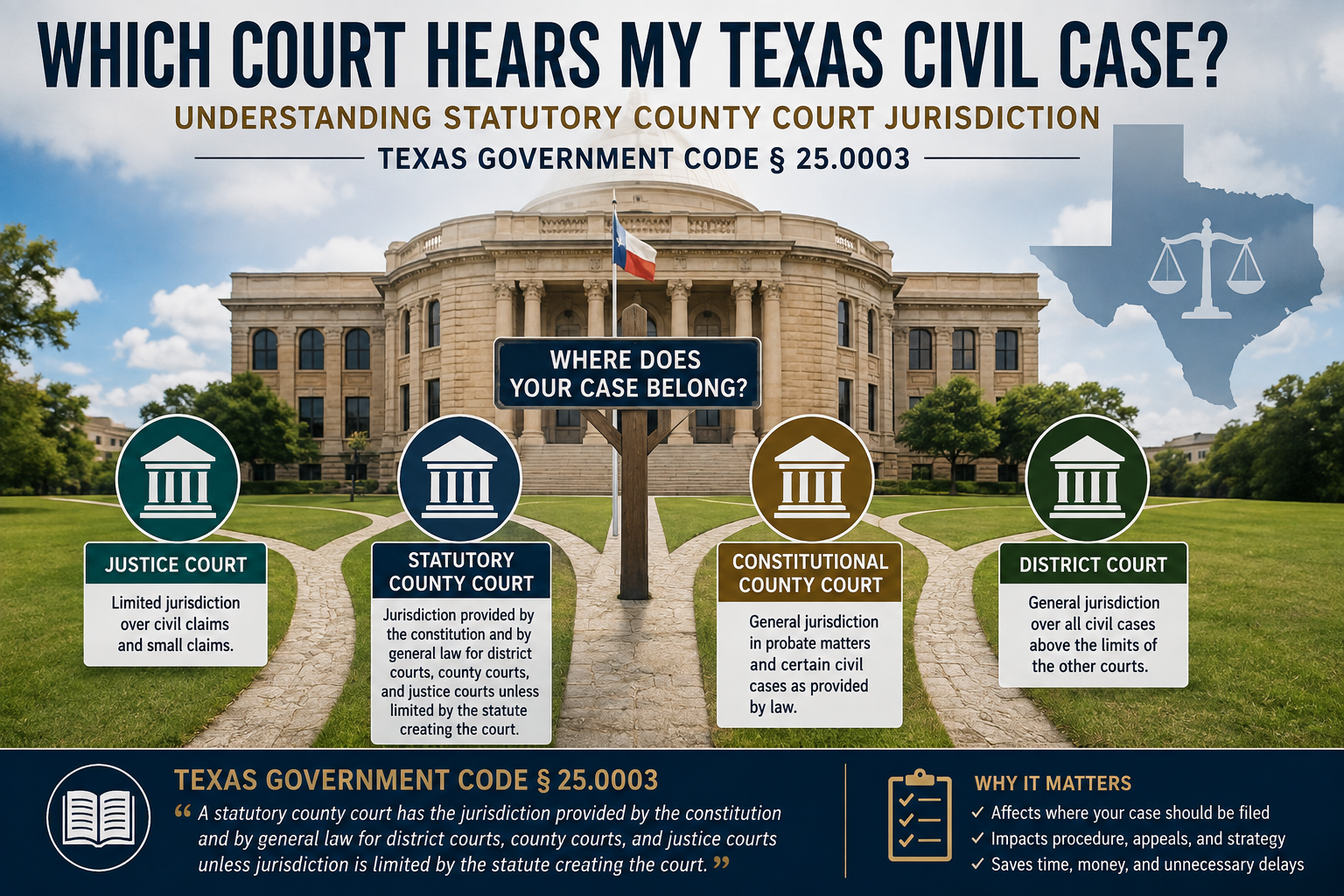
One of the most overlooked issues in Texas litigation is determining which court actually has authority to hear a particular lawsuit.Filing in the wrong court can delay your case, increase costs, and even result in dismissal or transfer.
While many Texans are familiar with justice courts and district courts, statutory county courts occupy an important middle ground. Their jurisdiction is governed primarily by the Texas Government Code, along with county-specific statutes and other jurisdictional provisions.
Understanding how these courts work can save litigants significant time and expense.
What Is a Statutory County Court?
Texas has several different types of trial courts:
- Justice Courts
- Constitutional County Courts
- Statutory County Courts
- District Courts
Unlike constitutional county courts, statutory county courts are created by the Legislature to address increasing caseloads in larger counties.
Their jurisdiction is not identical across every county. Instead, it depends on both statewide law and county-specific statutes contained throughout Chapter 25 of the Texas Government Code.
The Starting Point: Texas Government Code § 25.0003
Texas Government Code § 25.0003 provides the general framework for statutory county court jurisdiction.
It states in part:
"A statutory county court has the jurisdiction provided by the constitution and by general law for district courts, county courts, and justice courts unless jurisdiction is limited by the statute creating the court."
This seemingly simple language has significant consequences.
Rather than possessing only one type of jurisdiction, many statutory county courts exercise overlapping jurisdiction traditionally exercised by multiple Texas trial courts.
Concurrent Jurisdiction
The key concept is concurrent jurisdiction.
In many circumstances, both a district court and a statutory county court may have authority to hear the same dispute.
Examples frequently include:
- Contract disputes
- Business litigation
- Property disputes
- Probate matters (depending upon the county)
- Appeals from justice court
- Certain injunction proceedings
- Declaratory judgment actions
Exactly what may be heard depends upon the statutes governing that particular county.
Why County Matters
Many attorneys mistakenly assume every statutory county court operates the same way.
That is incorrect.
Chapter 25 of the Texas Government Code contains numerous county-specific provisions granting additional jurisdiction or limiting existing jurisdiction.
For example:
- Harris County statutory county courts possess jurisdiction different from smaller Texas counties.
- Dallas, Bexar, Tarrant, Montgomery, and Travis Counties likewise have specialized provisions.
Accordingly, attorneys should always consult both:
- Texas Government Code § 25.0003, and
- The statutes governing the particular county in which suit is filed.
Why Jurisdiction Matters
Jurisdiction affects numerous strategic decisions, including:
- where suit should be filed;
- whether removal or transfer is appropriate;
- available procedures;
- appellate routes;
- docket speed; and
- judicial assignment.
Choosing the proper court at the outset often reduces unnecessary litigation costs.
Filing in the Wrong Court
Texas courts generally prefer deciding cases on their merits rather than dismissing them over technical filing mistakes.
Nevertheless, filing in a court lacking subject matter jurisdiction can create significant procedural complications, including:
- motions challenging jurisdiction,
- delays,
- transfers between courts, and
- additional attorney's fees.
Careful jurisdictional analysis before filing often avoids these problems entirely.
A Practical Example
Suppose two businesses have a contract dispute involving several hundred thousand dollars.
Depending upon the county, a statutory county court may possess concurrent jurisdiction with the district court.
In another county, however, only the district court may hear the case.
The governing statutes—not simply the amount in controversy—determine the answer.
Final Thoughts
Jurisdiction is one of the least glamorous subjects in Texas civil procedure, yet it is among the most important.
Before drafting pleadings or paying filing fees, litigants and attorneys should confirm that the selected court actually possesses authority to hear the dispute. Texas Government Code Chapter 25 provides much of that answer, and because county-specific statutes differ, careful review is essential before filing suit.
Disclaimer: This article is for general educational purposes only and does not constitute legal advice. Every lawsuit presents unique jurisdictional questions, and you should consult a qualified Texas attorney regarding your specific circumstances.
At David C. Barsalou, Attorney at Law, PLLC, we help clients navigate business, family, tax, estate planning, and real estate matters ranging from document drafting to litigation with clarity and confidence. If you’d like guidance on your situation, schedule a consultation today. Call us at (713) 397-4678, email barsalou.law@gmail.com, or reach us through our Contact Page. We’re here to help you take the next step.