The LLC Is a Separate Legal Entity
One of the biggest legal misconceptions is that LLC members personally own the company's assets.
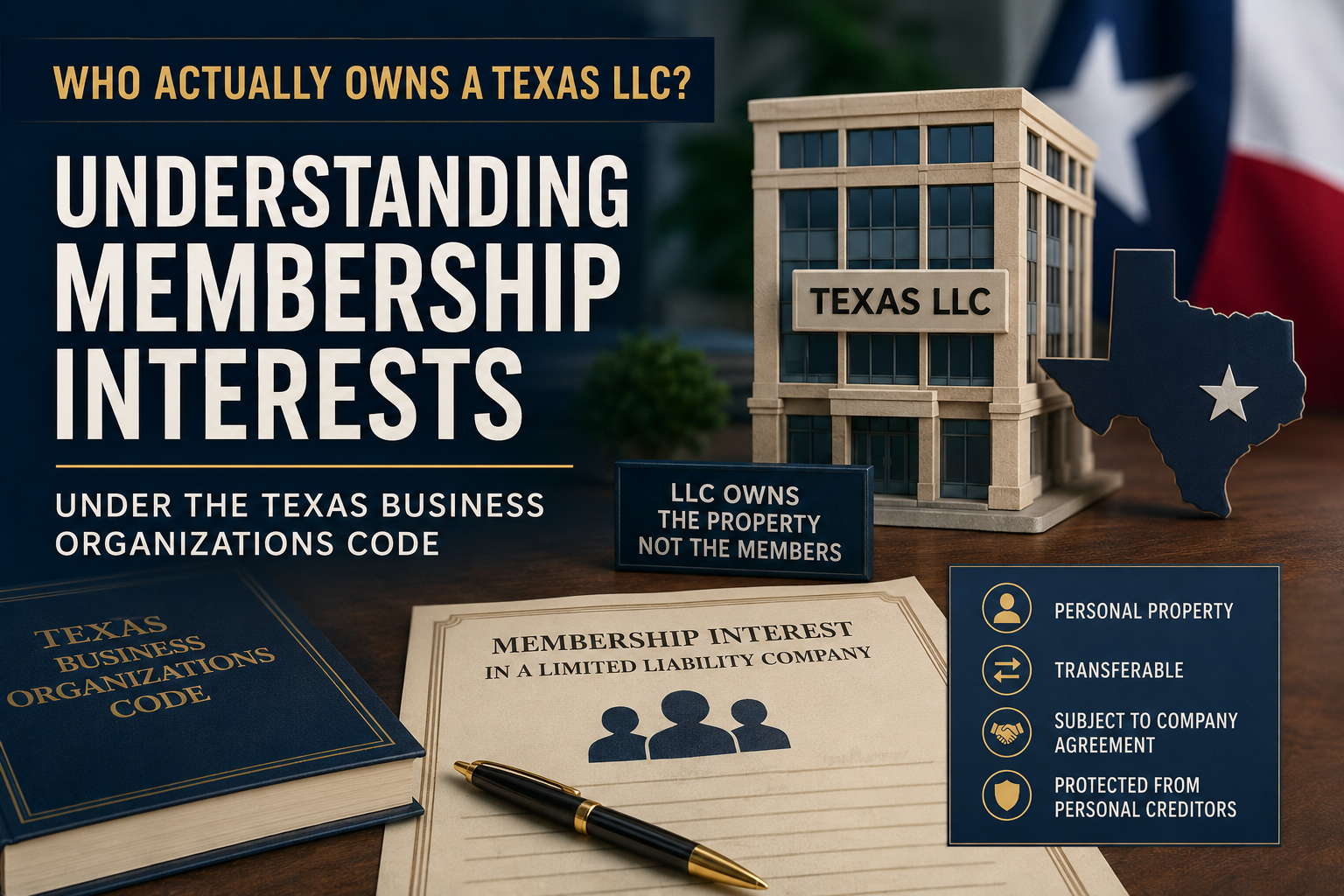
Under Texas law, an LLC itself owns its property—not the individual members.
The Texas Business Organizations Code provides:
"A membership interest in a limited liability company is personal property."
Tex. Bus. Orgs. Code § 101.106
That sentence carries enormous legal significance.
If your LLC owns:
- an office building,
- rental property,
- trucks,
- intellectual property,
- equipment,
- bank accounts,
those assets belong to the LLC, not directly to the members.
Instead, the member owns a membership interest, which is itself classified as personal property.
Why This Distinction Matters
This seemingly technical rule affects numerous legal situations.
For example:
- divorce
- probate
- creditor collections
- bankruptcy
- business sales
- estate planning
- charging orders
- taxation
Many lawsuits turn on understanding this distinction correctly.
Owning 100% of an LLC Does Not Mean You Own the Building
Suppose Jane forms:
Jane Investments LLC
The LLC purchases an office building.
Jane owns:
- 100% of the membership interests.
She does not legally own:
- the office building.
The LLC owns it.
That distinction often surprises business owners.
Why Creditors Care
Suppose Jane is sued personally.
Can the creditor simply seize the LLC's building?
Usually not.
The creditor generally reaches Jane's membership interest, not property owned by the LLC itself.
Texas law provides separate remedies—such as charging orders—for creditors attempting to collect against LLC members.
This is one reason LLCs are frequently used as liability-planning vehicles.
Membership Interests Can Be Sold
Membership interests are transferable, although the transfer may not automatically make the purchaser a member with governance rights.
Many company agreements distinguish between:
- economic rights
- management rights
- voting rights
Without reviewing the governing documents, buyers sometimes discover they purchased only part of what they expected.
Company Agreements Often Control
The Texas Business Organizations Code gives LLC members tremendous flexibility.
A properly drafted company agreement may govern:
- admission of new members
- transfers
- buyout procedures
- voting thresholds
- distributions
- management authority
- restrictions on ownership transfers
For closely held businesses, these provisions can become critically important when owners disagree.
Probate Issues
Suppose an LLC member dies.
The deceased member's heirs may inherit the membership interest, but they do not necessarily step directly into management.
Whether they obtain governance rights often depends upon:
- the Texas Business Organizations Code,
- the company agreement,
- and any applicable probate proceedings.
This distinction frequently surprises families handling an estate.
Divorce Issues
Membership interests are also frequently involved in divorce litigation.
The court may need to determine:
- whether the membership interest is community or separate property,
- its value,
- whether transfer restrictions affect valuation,
- whether distributions should be considered.
The LLC itself may never become a party to the divorce, yet its value can become a central issue.
Selling the Business
Many owners say:
"I'm selling my LLC."
Legally, however, there are several different possibilities.
A transaction may involve:
- sale of membership interests,
- sale of company assets,
- merger,
- conversion,
- reorganization.
Each has different legal and tax consequences.
Understanding what is actually being sold is essential.
Common Mistakes
Business owners often mistakenly believe:
- they personally own LLC property;
- LLC bank accounts are personal funds;
- they can freely transfer ownership without reviewing the company agreement;
- heirs automatically become managers after death;
- creditors may immediately seize LLC assets after obtaining a judgment against a member.
Each of these assumptions can create significant legal problems.
Practical Takeaways
Texas LLC owners should remember:
- A membership interest is personal property under Texas law.
- The LLC—not its members—owns company assets.
- Company agreements often determine who may become a member and under what conditions.
- Probate, divorce, creditor collections, and business sales frequently depend upon these distinctions.
- Careful legal planning can prevent expensive disputes later.
Final Thoughts
The Texas Business Organizations Code deliberately separates ownership of an LLC from ownership of the LLC's property. While that distinction may appear highly technical, it has practical consequences in nearly every stage of a business's life—from formation and financing to litigation, divorce, probate, and succession planning.
Understanding the legal nature of a membership interest can help business owners make better decisions and avoid costly misunderstandings before they arise.
At David C. Barsalou, Attorney at Law, PLLC, we help clients navigate business, family, tax, estate planning, and real estate matters ranging from document drafting to litigation with clarity and confidence. If you’d like guidance on your situation, schedule a consultation today. Call us at (713) 397-4678, email barsalou.law@gmail.com, or reach us through our Contact Page. We’re here to help you take the next step.
