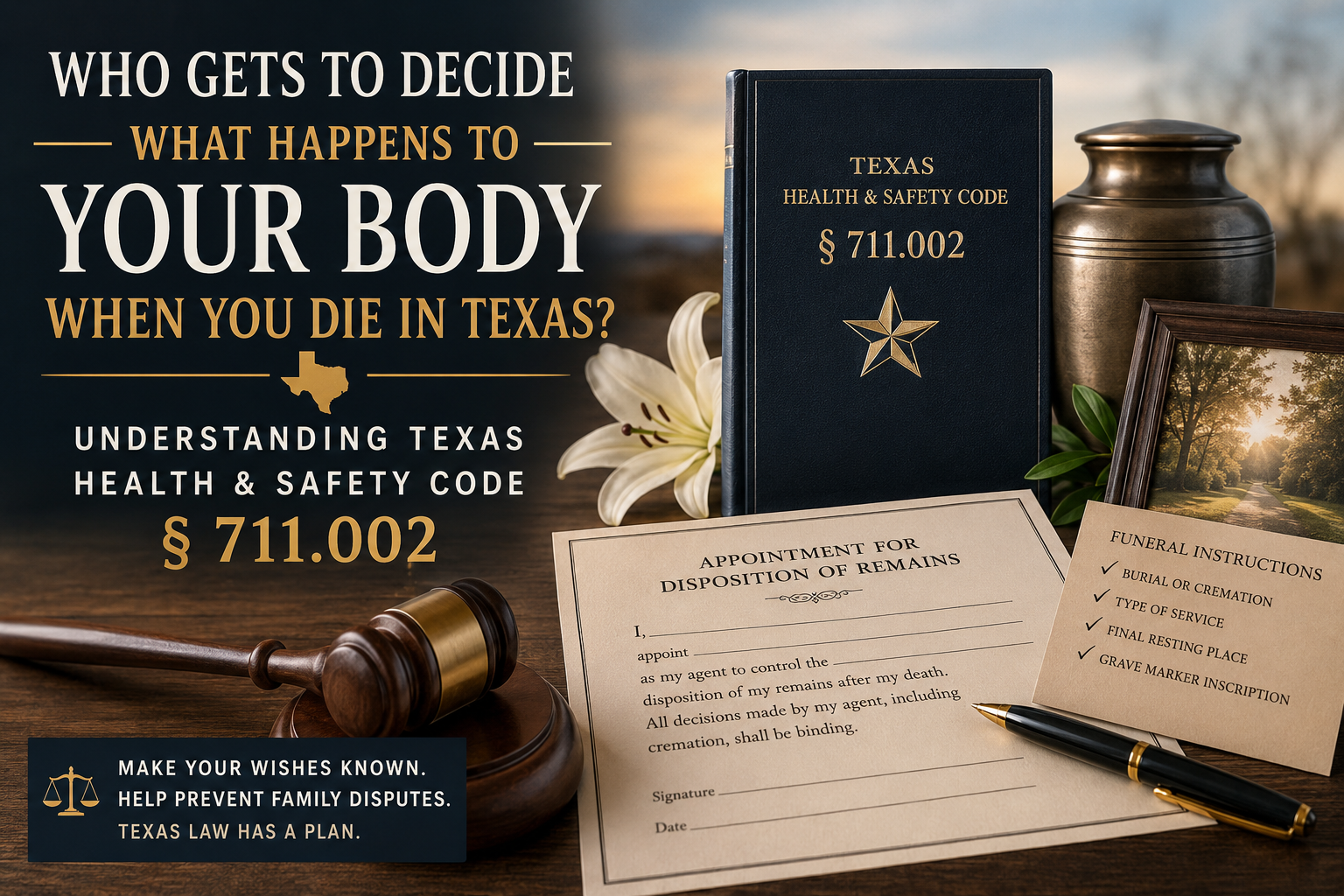
Most people think of estate planning as deciding who receives their house, money, investments, and personal belongings after death.
Texas law, however, addresses a considerably more immediate question:
Who gets to decide what happens to your body?
Families sometimes disagree about whether a deceased relative should be buried or cremated, where the remains should be placed, what kind of funeral should occur, or even what should appear on the grave marker.
Texas does not simply leave those disputes to whoever reaches the funeral home first.
Texas Health and Safety Code § 711.002 establishes rules governing who may control the disposition of a deceased person's remains—and allows a person to leave legally significant instructions before death.
The statute is unusually detailed and can become extremely important when family members disagree.
Texas Law Establishes a Priority List
If a person dies without leaving qualifying written directions concerning the disposition of the person's remains, Texas Health and Safety Code § 711.002(a) establishes a hierarchy of people who may control what happens.
The statute begins by providing that, unless written directions control, specified persons:
“in the priority listed, have the right to control the disposition, including cremation, of the decedent's remains”
The priority generally begins with:
- a person specifically designated by the decedent in a signed written instrument;
- the surviving spouse;
- a surviving adult child;
- a surviving parent;
- a surviving adult sibling;
- a duly qualified executor or administrator; and
- an adult person in the next degree of kinship in the order provided by inheritance law.
This hierarchy can produce results that surprise families.
For example, an executor named to administer an estate does not necessarily have first priority over a surviving spouse, adult child, or parent.
The right to administer someone's property after death and the right to determine what happens to the person's remains are related estate matters, but they are not necessarily the same legal authority.
You Can Appoint Someone Specifically to Control Your Remains
One of the more unusual features of § 711.002 is that Texas allows a person to designate an agent specifically for this purpose.
The statute even supplies a model document titled:
“APPOINTMENT FOR DISPOSITION OF REMAINS”
The instrument allows a person to appoint an agent who will control the disposition of the person's remains after death.
That authority may include decisions concerning cremation.
The statutory form states:
“All decisions made by my agent with respect to the disposition of my remains, including cremation, shall be binding.”
In other words, Texas law allows someone to appoint what amounts to a very specialized post-death decision-maker.
The person controlling the body does not necessarily need to be the same person serving as executor of the estate.
That distinction can be useful when someone trusts one person to manage financial affairs but wants someone else to handle funeral and burial decisions.
The Appointment Has Formal Requirements
Simply telling a friend, “I want you to handle my funeral,” does not necessarily create the statutory appointment.
Section 711.002(c) establishes requirements for a legally sufficient written instrument.
Among other things, the instrument must designate the person who will control disposition of the remains, be signed by the person making the designation, and have the signature acknowledged.
The agent or successor agent must also sign before acting as the decedent's agent.
The statute therefore provides a formal mechanism for making the person's intentions much clearer than an informal conversation with relatives.
Divorce Can Revoke Your Former Spouse's Appointment
There is another interesting estate-planning wrinkle.
Suppose someone signs an appointment naming a spouse as the agent responsible for disposition of remains. The couple later divorces, but the person never updates the document.
Section 711.002(c) generally provides that, unless the instrument says otherwise, designation of the spouse as an agent or successor agent is revoked when the marriage is dissolved by divorce, annulment, or a declaration that the marriage is void before the person's death.
This is similar in spirit to other estate-planning rules that recognize that a person's intentions toward a former spouse may change dramatically after divorce.
It is also another reason estate-planning documents should be reviewed after major life events.
Can You Put Funeral Instructions in Your Will?
Yes.
Texas Health and Safety Code § 711.002(g) expressly allows a person to provide written directions concerning disposition of remains in:
- a will;
- a prepaid funeral contract; or
- another signed and acknowledged written instrument.
Those instructions can address burial or cremation and may even govern the inscription placed on a grave marker under the circumstances specified by the statute.
Section 711.002(g) provides that the person otherwise entitled to control disposition:
“shall faithfully carry out the directions of the decedent”
to the extent that the estate or person controlling disposition is financially able to do so.
That is considerably stronger than treating funeral wishes as merely sentimental suggestions.
Funeral Instructions in a Will Do Not Have to Wait for Probate
This may be the strangest—and most practical—part of the statute.
Ordinarily, provisions in a will become legally significant through the probate process.
Funeral arrangements obviously cannot wait several weeks for a probate application, hearing, and order admitting a will to probate.
Texas law expressly accounts for that problem.
Section 711.002(h) states:
“If the directions are in a will, they shall be carried out immediately without the necessity of probate.”
That makes perfect practical sense.
A family cannot place someone's remains in cold storage while waiting for the probate docket.
Even more remarkably, the statute provides protection when the supposed will ultimately does not become an effective testamentary instrument. If the will is never probated or is later declared invalid for testamentary purposes, the disposition directions remain valid to the extent they were already carried out in good faith.
The law therefore separates the immediate problem of handling someone's remains from the slower legal process of determining who receives the person's property.
What If the Family Cannot Agree?
Family disputes over remains can become intensely emotional.
Texas law provides a judicial solution.
Section 711.002(k) states that disputes among persons claiming the right to control disposition of remains are resolved by a court with jurisdiction over probate proceedings for the decedent.
Importantly, the court can resolve the dispute:
“regardless of whether a probate proceeding has been initiated.”
That means a family does not necessarily need to wait for an ordinary estate administration before seeking judicial intervention.
The statute also protects funeral establishments and cemetery organizations that refuse to proceed while a genuine dispute remains unresolved.
You Can Lose Your Priority by Waiting Too Long
The statutory right to make these decisions is not indefinite.
Section 711.002(a-1) contains a surprisingly specific deadline.
If the person with the right to control disposition fails to make final arrangements—or appoint someone else to do so—before the earlier of:
- the sixth day after receiving notice of the death; or
- the tenth day after the decedent died,
the person is presumed unable or unwilling to control disposition.
The person's right then terminates and passes according to the statutory priority rules.
This is another example of the practical nature of the statute.
Decisions concerning remains cannot remain unresolved indefinitely.
The Person Making the Decision May Also Be Responsible for the Cost
Authority can come with financial responsibility.
Section 711.002(a-3) generally provides that a person exercising the right to control disposition under the statutory hierarchy—other than a duly qualified executor or administrator—is liable for the reasonable cost of interment.
That person may seek reimbursement from the decedent's estate.
When an executor or administrator exercises the right in that official capacity, the statute instead places responsibility for the reasonable cost on the estate rather than imposing individual liability on the representative.
So volunteering to take control of funeral arrangements can have financial consequences, even when reimbursement may later be available.
Texas Law Can Disqualify Certain People from Controlling the Remains
The statute contains an important exception to the normal family hierarchy.
Section 711.002(l) prevents certain people from controlling disposition when circumstances surrounding the death involve specified family-violence crimes or protective orders.
For example, the statute can disqualify a person who, in connection with the decedent's death, has been arrested or is subject to an arrest warrant for certain crimes involving family violence against the decedent.
It can also apply when qualifying protective-order proceedings existed between the decedent and the person who would otherwise claim authority.
Texas law therefore does not mechanically give control of a victim's remains to a person merely because that person would ordinarily occupy a high position in the statutory family hierarchy.
What If Nobody Is Available?
Texas law even addresses that uncomfortable possibility.
Section 711.002(e) provides a final governmental backstop when no person has the duty to inter the remains.
If an inquest is held, the person conducting the inquest is responsible for interment.
If no inquest is held, responsibility ultimately falls upon the county in which the death occurred.
Someone, legally speaking, must eventually take responsibility.
Funeral Wishes Are More Than an Estate-Planning Afterthought
People understandably devote far more attention to wills, trusts, beneficiary designations, and property transfers than to the legal disposition of their remains.
But disputes over funerals and burial can arise at exactly the moment when family members are least equipped to resolve them calmly.
Texas Health and Safety Code § 711.002 provides a surprisingly comprehensive solution.
A person can leave written directions.
A person can appoint a specific agent.
Texas law establishes a hierarchy when no controlling instructions exist.
It imposes deadlines when the person with priority does not act.
And probate courts can resolve disputes when competing relatives cannot agree.
Perhaps most unusually, Texas law recognizes that death creates one legal problem that cannot wait for probate.
A will may take time to administer.
A funeral cannot.
For Texans with strong preferences about burial, cremation, funeral arrangements, or the person who should make those decisions, documenting those wishes properly can prevent an already difficult moment from becoming a legal dispute.
At David C. Barsalou, Attorney at Law, PLLC, we help clients navigate business, family, tax, estate planning, and real estate matters ranging from document drafting to litigation with clarity and confidence. If you’d like guidance on your situation, schedule a consultation today. Call us at (713) 397-4678, email barsalou.law@gmail.com, or reach us through our Contact Page. We’re here to help you take the next step.