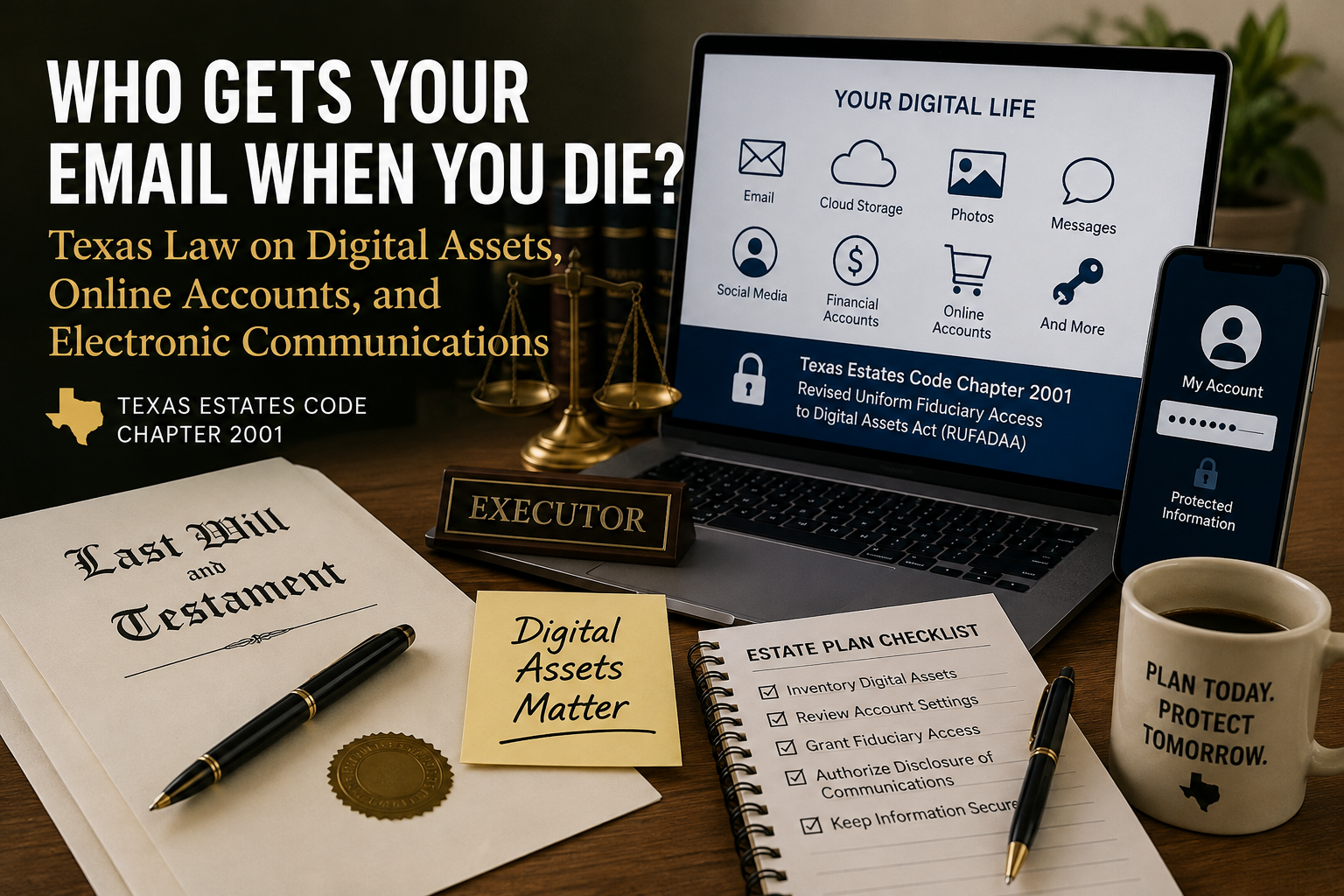
When most people think about probate, they think about houses, bank accounts, vehicles, personal belongings, and perhaps a box of old family photographs.
Modern estates contain something else: digital property.
A deceased person may leave behind decades of email, photographs stored in the cloud, social-media accounts, online business records, electronically stored documents, subscription accounts, domain names, cryptocurrency records, and other information that may exist almost entirely online.
That raises an oddly modern probate question:
Can an executor simply log into a deceased person's accounts?
Not necessarily.
Texas has enacted an entire statutory framework addressing the problem: the Texas Revised Uniform Fiduciary Access to Digital Assets Act, found in Chapter 2001 of the Texas Estates Code. The law attempts to balance two competing interests: allowing fiduciaries to administer property while respecting the privacy choices made by the person who originally owned the account. (Texas Statutes)
Texas Law Actually Defines a "Digital Asset"
Texas Estates Code § 2001.002 contains definitions that sound considerably more like something from Silicon Valley than traditional probate law.
The statute defines an "account" as an arrangement under a terms-of-service agreement through which a custodian maintains, processes, receives, or stores a user's digital asset or provides goods or services to the user.
It separately recognizes the content of electronic communications and a catalog of electronic communications. The distinction matters because knowing that someone exchanged emails with a particular person is legally different from obtaining the actual contents of those emails. (Texas Statutes)
This means that administering a twenty-first-century estate can involve considerably more than locating a checking account and recording a deed.
The executor may need access to information that exists on somebody else's computer servers.
The Strange Part: An Online Setting Can Override Your Will
Perhaps the most interesting provision is Texas Estates Code § 2001.051.
The statute allows a user to employ an "online tool" provided by the custodian to direct whether digital assets should be disclosed to a designated recipient.
More surprisingly, the statute provides:
"a direction regarding disclosure using an online tool overrides a contrary direction by the user in a will"
if the online tool permits the user to modify or delete the direction at all times. Tex. Est. Code § 2001.051(a). (Justia Law)
Think about how unusual that is.
A person could execute a carefully drafted will containing instructions concerning digital information. But if that person later—or perhaps earlier—uses a qualifying online account-management tool and gives inconsistent instructions, the online direction can control.
Texas law therefore recognizes something resembling a hierarchy of digital-estate instructions.
What If You Never Used an Online Tool?
The statute addresses that situation too.
Texas Estates Code § 2001.051(b) provides that if the user did not use such an online tool, or the custodian did not provide one, the user may authorize or prohibit disclosure of digital assets to a fiduciary through a:
- will;
- trust;
- power of attorney; or
- other record.
That authorization can include the content of electronic communications. (Justia Law)
This is one reason modern estate planning should not necessarily stop with language such as "I give all the rest and residue of my estate to my children."
Digital information may require its own planning.
Your Executor Does Not Automatically Get to Read Your Email
The difference between owning or administering an estateand having access to private communications is particularly important.
Texas Estates Code § 2001.101 governs disclosure of the contents of a deceased user's electronic communications.
The statute generally requires that the deceased user have consented to disclosure or that a court direct disclosure. A personal representative seeking the communications must provide certain documentation, which can include a written request, certified death certificate, and certified letters testamentary or letters of administration. (Justia Law)
Depending upon the circumstances, the custodian may also request information identifying the particular account, evidence connecting the account to the deceased user, or certain findings from the probate court. (FindLaw)
So being named executor does not necessarily mean:
"Here is the password. Read everything."
There is a legal process.
Texas Probate Courts Can Enter Digital-Asset Orders
Texas Estates Code § 351.106 gives personal representatives another important tool.
A personal representative may apply for a court order concerning digital assets before the estate administration is closed. Among other things, the court may enter an order directing disclosure of electronic communications or directing a custodian to comply with a proper request under Chapter 2001. (Justia Law)
That provision can become particularly important when digital information is necessary to identify or administer estate property.
Imagine, for example, that the executor knows the deceased operated an online business but cannot determine where its financial records are located.
Or suppose important records concerning property, debts, taxes, or contractual obligations exist only in an email account.
Digital access can cease being a matter of curiosity and become an actual estate-administration problem.
An Executor's Authority Is Not Unlimited
There is another important limitation.
Texas Estates Code § 2001.201 applies traditional fiduciary duties to digital assets, including the duties of care, loyalty, and confidentiality.
The statute also makes clear that fiduciary authority remains subject to applicable law and, in appropriate circumstances, applicable terms of service. Perhaps most memorably, it states that the fiduciary's authority:
"may not be used to impersonate the user."
Tex. Est. Code § 2001.201(b)(4). (FindLaw)
In other words, an executor who receives lawful access to someone's digital property does not simply become that person online.
Authority to administer an account is not authority to assume the deceased person's identity.
What Counts as Valuable Digital Property?
The subject is broader than email.
Depending upon the circumstances, a modern estate might include or depend upon access to digital material involving photographs, cloud storage, electronically maintained business records, websites and domain names, electronically stored intellectual property, online financial information, digital currencies, or other electronically maintained property or records.
Not everything associated with an online account is necessarily transferable property. Contract rights, intellectual-property law, privacy law, terms of service, and the particular nature of the asset may all matter.
That is precisely why the distinction between the underlying asset and access to the account containing information about that asset can become important.
For example, having authority over an estate does not necessarily mean that a fiduciary can bypass every technological or legal restriction imposed on an online account.
Passwords Are Not an Estate Plan
One tempting solution is simply to leave somebody a list of usernames and passwords.
That may be practically useful in some situations, but it does not answer the legal questions created by Chapter 2001.
The statute expressly contemplates legally authorized disclosure by custodians and directions concerning disclosure made by the user. (Justia Law)
There are also obvious security concerns with putting sensitive passwords directly into a will. Once admitted to probate, wills generally become part of the court's records.
A better estate plan may therefore distinguish among:
ownership, fiduciary authority, disclosure consent, and the practical information necessary to locate digital assets.
Those are related concepts, but they are not necessarily the same thing.
Digital Estate Planning Is Becoming Ordinary Estate Planning
Twenty years ago, a probate lawyer could reasonably expect most significant estate property to leave a paper trail.
That assumption becomes less reliable every year.
Important family photographs may exist only in cloud storage. Business records may exist only in an email account. Financial information may be accessible through an application rather than a filing cabinet. An online account may even contain instructions that legally override inconsistent provisions in traditional estate-planning documents.
Texas law has adapted by giving fiduciaries mechanisms for obtaining digital assets while also allowing individuals to control whether their private electronic communications should be disclosed.
The strange result is that one of the most important estate-planning documents you create may not look like a legal document at all.
It might be a setting you clicked inside an online account years ago.
Talk to a Texas Probate and Estate Planning Attorney
Digital assets can create unexpected problems in probate, particularly when a deceased person operated a business online, stored important documents electronically, or left substantial information in password-protected accounts.
A Texas probate or estate-planning attorney can help determine what authority an executor or other fiduciary has, whether court authorization is necessary, and how estate-planning documents should address access to digital property.
This article is for general informational purposes only and does not constitute legal advice. Every estate and digital account presents different facts, contractual terms, and legal issues.
At David C. Barsalou, Attorney at Law, PLLC, we help clients navigate business, family, tax, estate planning, and real estate matters ranging from document drafting to litigation with clarity and confidence. If you’d like guidance on your situation, schedule a consultation today. Call us at (713) 397-4678, email barsalou.law@gmail.com, or reach us through our Contact Page. We’re here to help you take the next step.