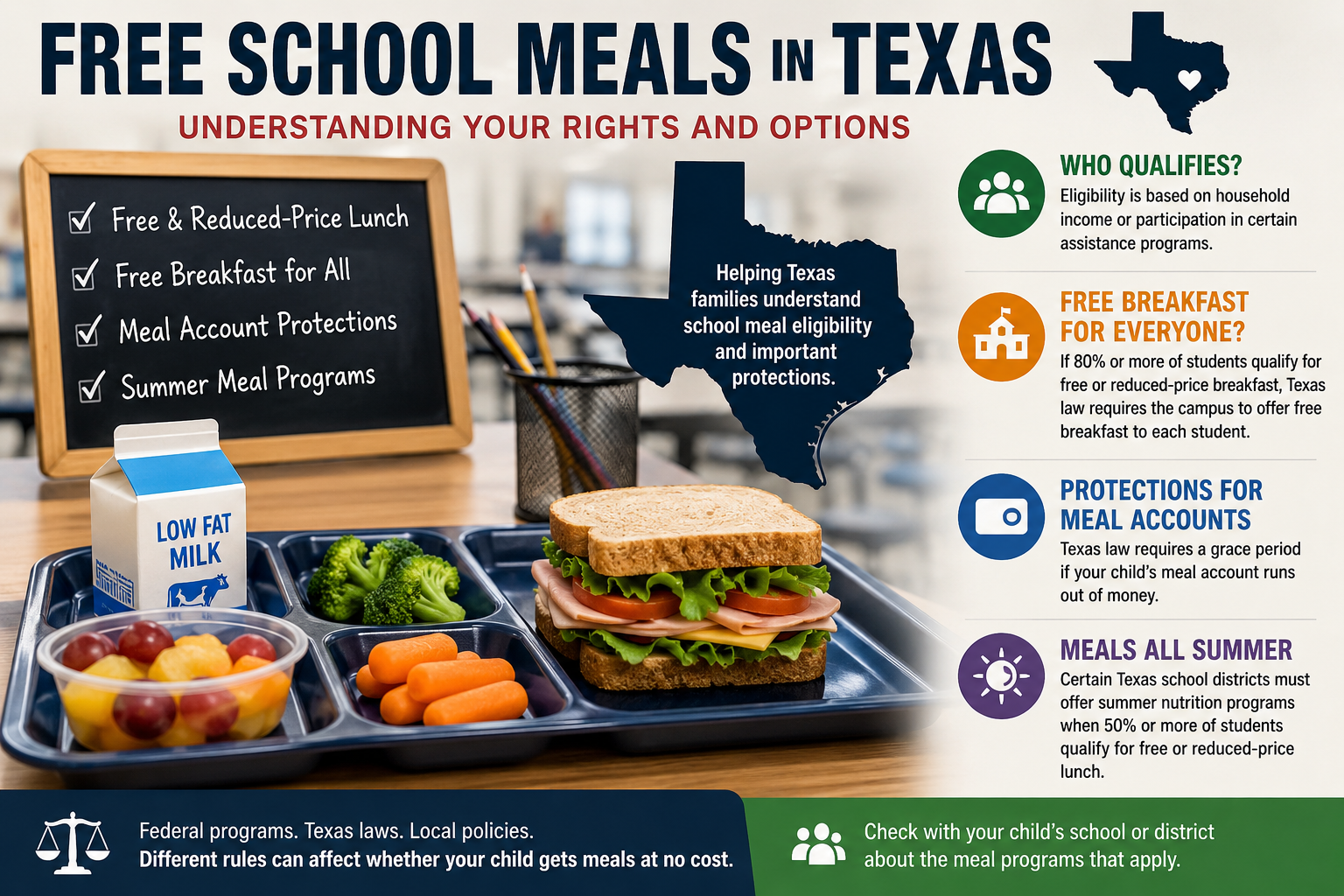
For millions of families, the school cafeteria is about more than deciding whether today's mystery entrée looks appetizing.
School breakfast and lunch programs can provide substantial financial assistance to families, particularly when several children attend school.
But who is actually entitled to receive free school meals in Texas?
The answer is more complicated than simply looking for a Texas statute establishing a particular income limit.
Texas school meal programs operate through an intersection of federal law, federal nutrition programs, Texas statutes, and local school administration. Some students qualify individually because of household income or participation in certain assistance programs. In other situations, every student at a particular school may receive a free meal regardless of an individual family's income.
Texas law also contains some surprisingly specific provisions governing school breakfast programs, meal-account balances, food donations, and summer nutrition programs.
The National School Lunch Program Is Primarily a Federal Program
The familiar system of free and reduced-price school meals originates principally with federal law.
The National School Lunch Program, or NSLP, is a federally assisted meal program operating in public and nonprofit private schools and certain residential child-care institutions.
Eligibility for free or reduced-price meals is generally determined using federal income standards.
Under the traditional income-based system, children from households with income at or below 130 percent of the federal poverty levelgenerally qualify for free meals, while children from households with income between 130 percent and 185 percent of the federal poverty level generally qualify for reduced-price meals.
The applicable dollar amounts change from year to year.
For the period from July 1, 2026 through June 30, 2027, the Texas Department of Agriculture publishes the following annual household-income limits:
Household Size
Free Meals
Reduced-Price Meals
1
$20,748
$29,526
2
$28,132
$40,034
3
$35,516
$50,542
4
$42,900
$61,050
5
$50,284
$71,558
6
$57,668
$82,066
7
$65,052
$92,574
8
$72,436
$103,082
For households larger than eight people, additional amounts are added for each additional household member.
Because these income guidelines are adjusted periodically, parents should consult the current guidelines rather than assume that figures from a prior school year remain applicable.
Some Children Can Qualify Without a Traditional Income Application
Income is not the only way a child may become eligible for free school meals.
Federal law provides mechanisms through which certain children can be categorically eligible for free meals. This can include children associated with certain public-benefit programs or circumstances recognized by federal law.
Texas has enacted its own law to help identify these children.
Texas Agriculture Code § 12.041 requires the Texas Department of Agriculture, Texas Education Agency, and Health and Human Services Commission to use applicable information maintained by those agencies, at least quarterly, to identify children who are categorically eligible for free meals under the national free or reduced-price breakfast and lunch program.
The statute also addresses the use of information maintained through programs such as SNAP and Medicaid for verification purposes.
The practical significance is important.
A family should not necessarily assume that eligibility for free school meals always requires completing a traditional application based exclusively on household wages. Some children may qualify through categorical or direct-certification procedures.
Texas Law Also Regulates School Breakfast Programs
Although the principal school nutrition programs are federal, Texas law imposes additional requirements concerning breakfast.
Under Texas Education Code § 33.901, if at least 10 percent of students enrolled in one or more schools in a district—or in an open-enrollment charter school—are eligible for free or reduced-price breakfasts under the federal School Breakfast Program, the district or charter school generally must either participate in the national program and make its benefits available to eligible students or establish a qualifying locally funded program.
The statute therefore does more than simply permit school districts to provide breakfast.
Under specified circumstances, it affirmatively requires a breakfast program.
Some Texas Schools Must Offer Free Breakfast to Every Student
Texas law contains an even more interesting rule.
Under Texas Education Code § 33.901(b), a school district campus or open-enrollment charter school participating in the national School Breakfast Program, or providing the qualifying locally funded program, must offer a free breakfast to each student if 80 percent or more of the students qualify for a free or reduced-price breakfast under the national program.
Notice what that means.
The statute does not merely require the school to provide free breakfast to the 80 percent who individually qualify.
It requires the qualifying campus to offer free breakfast to each student.
Consequently, a child whose family income would ordinarily be too high to qualify individually for a free breakfast may nevertheless receive one because of the overall eligibility rate at the child's campus.
That is an important distinction between individual eligibility and schoolwide meal availability.
Can a School Obtain a Waiver From the 80 Percent Rule?
Yes, but Texas law establishes a particular procedure.
Texas Education Code § 33.901(c) provides for a waiver of the schoolwide free-breakfast requirement for a period not exceeding one year.
The school district's board of trustees or charter school's governing body must vote to request the waiver at the applicable annual budget meeting.
The waiver must also be listed as a separate agenda item, and the public must be provided an opportunity to comment before the vote.
Thus, parents at a qualifying campus may have an opportunity to participate in the public process if the district seeks to avoid the otherwise applicable free-breakfast requirement.
What Happens When a Student's Lunch Account Runs Out of Money?
Texas law even addresses the familiar problem of an empty school meal account.
Under Texas Education Code § 33.908, a school district that allows students to purchase meals using prepaid meal cards or accounts must adopt a grace-period policy addressing exhausted or insufficient balances.
During the grace period established by the board, the student must be permitted to continue purchasing meals either by accumulating a negative balance or through another extension of credit.
The district must also notify the student's parent of the exhausted or insufficient balance.
The existence of a grace-period requirement does not mean that every student has an unlimited legal right to accumulate school-lunch debt indefinitely. The statute instead requires districts using these systems to establish a policy that provides a temporary mechanism for dealing with insufficient balances.
Parents should therefore review the particular district's meal-account policy to determine how long its grace period lasts and what happens afterward.
Texas Law Allows Schools to Provide Donated Food to Students
Texas has another provision intended to address situations in which students cannot afford food.
Under Texas Education Code § 33.907, school districts and open-enrollment charter schools may participate in programs through which certain food is donated to nonprofit organizations for distribution on campus.
The statute also allows a district or charter school to adopt a policy under which food is provided at no cost to a student who is unable to purchase breakfast, lunch, dinner, or a snack.
This is another reason the question “Does this student qualify for a free lunch?” does not always have a simple yes-or-no answer based solely on household income.
Different legal and administrative mechanisms may provide meals in different circumstances.
Some Schools May Provide Free Meals to Everyone
Parents should also be aware that some schools participate in federal programs that permit meals to be provided to all students without requiring every household to establish individual eligibility.
One important example is the Community Eligibility Provision, commonly called CEP.
Schools participating in CEP can provide breakfast and lunch to all enrolled students at no charge rather than collecting traditional household applications from each family.
Accordingly, a parent whose household income substantially exceeds the ordinary free-meal threshold should not assume that a notice stating that all students receive free meals must be a mistake.
The student's school may be participating in a schoolwide program.
What About School Meals During the Summer?
Texas law also addresses nutrition when school is not in regular session.
Under Texas Agriculture Code § 12.0029, a school district in which at least 50 percent of students are eligible to participate in the national free or reduced-price lunch program is generally subject to requirements concerning the operation of a summer nutrition program, unless the district receives an applicable waiver.
These programs can provide meals to children during the summer months when ordinary school meal programs are unavailable.
Summer-meal eligibility and site rules can differ from the rules governing an individual student's school-year lunch account. Families looking for summer meals should therefore check the current Texas summer nutrition program and participating sites rather than assuming that the same application process necessarily applies.
Free School Meals Can Have Legal Significance Beyond the Cafeteria
Eligibility for the National School Lunch Program can sometimes matter for purposes other than receiving breakfast or lunch.
Texas education law and administrative programs sometimes use eligibility for the National School Lunch Program as a measure of whether a student is economically disadvantaged.
That means the eligibility determination can affect educational data, funding, programs, and other benefits beyond the actual price charged at the cafeteria.
This is one reason school districts may continue collecting or determining eligibility information even in situations where students at a particular campus receive meals without charge.
So, Is a Texas Student Legally Entitled to a Free Lunch?
Sometimes—but the source of that entitlement matters.
There is no simple statewide rule providing free lunch to every Texas public-school student.
Instead, several different pathways may lead to a student receiving meals at no cost.
A child may individually qualify under federal income standards. A child may be categorically eligible because of participation in certain assistance programs or other qualifying circumstances. A school may participate in a program that provides free meals to every student. Texas law may require schoolwide free breakfast at a campus meeting the 80 percent threshold. Other state-law provisions address insufficient meal-account balances, donated food, and summer nutrition.
For parents, the most practical first step is generally to determine which meal program the child's particular school participates in.
If individual eligibility is required, the family can then determine whether its household income or other circumstances qualify the child for free or reduced-price meals.
And if a child has been denied benefits that a parent believes the child should receive, the parent should request information from the school or district explaining the eligibility determination and the procedures available to challenge or correct it.
The Bottom Line
“Free school lunch” sounds like a simple concept.
Legally, it is not.
Texas school meals operate through a combination of federal nutrition law, annual federal income standards, Texas statutes, state-agency administration, and local school policies.
For the 2026–2027 school year, income-based eligibility can provide free or reduced-price meals to qualifying households. But income is only part of the picture. Categorical eligibility, direct certification, schoolwide programs, Texas's universal-breakfast requirement at certain high-eligibility campuses, meal-account grace periods, food-donation programs, and summer nutrition programs can all affect whether a Texas child receives food at no charge.
For families trying to understand their rights, the best question may therefore be more specific than simply:
“Does my child qualify for free lunch?”
Instead, ask:
“Which school meal program applies to my child, and what are its eligibility rules?”
That question is much more likely to lead to the right answer.
This article is intended for general informational purposes only and does not constitute legal advice. School nutrition programs, income guidelines, and administrative requirements may change, and families should consult current program materials and their child's school district regarding individual eligibility.
At David C. Barsalou, Attorney at Law, PLLC, we help clients navigate business, family, tax, estate planning, and real estate matters ranging from document drafting to litigation with clarity and confidence. If you’d like guidance on your situation, schedule a consultation today. Call us at (713) 397-4678, email barsalou.law@gmail.com, or reach us through our Contact Page. We’re here to help you take the next step.