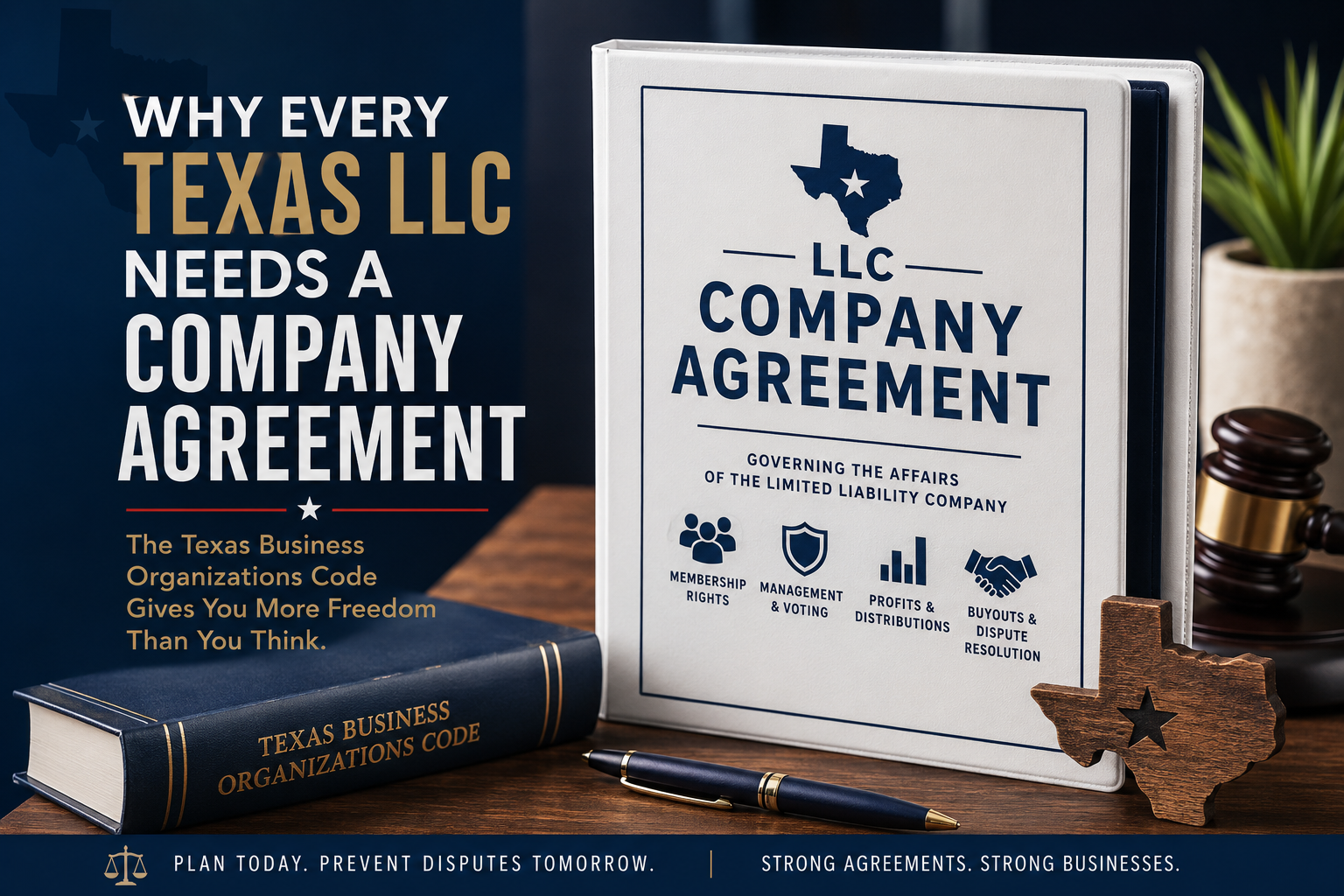
When people form a Texas limited liability company (LLC), they often believe that filing a Certificate of Formation is enough. In reality, one of the most important legal documents for any Texas LLC is its Company Agreement (commonly called an Operating Agreement).
Surprisingly, many Texas LLCs—especially closely held businesses owned by family members or friends—operate without one. That can create unnecessary disputes over ownership, management, distributions, voting rights, and what happens when an owner wants to leave.
Fortunately, the Texas Business Organizations Code ("TBOC") gives LLC owners remarkable flexibility to define their own rules.
What Is a Company Agreement?
The Texas Business Organizations Code recognizes a company agreement as the governing contract among the members and, in some circumstances, the managers and the company itself.
Section 101.001 defines a company agreement broadly enough to include agreements that are:
"...written, oral, or implied..." governing the affairs of the limited liability company and the conduct of its business.
This flexibility is somewhat unusual. While a carefully drafted written agreement is almost always preferable, Texas law recognizes that LLC governance may arise in more than one form.
The Texas Legislature Prefers Freedom of Contract
One of the defining characteristics of Texas LLC law is that the Legislature generally allows business owners to structure their relationships however they choose.
The Texas Business Organizations Code provides:
"Except as otherwise provided by this code, a company agreement governs:
(1) the relations among the members, managers, and officers of the company;
(2) the rights and duties under this code of a person in the capacity of manager, member, or officer;
(3) the company's activities and affairs; and
(4) the procedure and requirements for amending the company agreement."
Tex. Bus. Orgs. Code § 101.052.
In other words, the statute often supplies default rules, but the owners are frequently free to replace those rules with provisions that better fit their business.
What Can a Company Agreement Control?
A properly drafted company agreement may address issues such as:
- Voting rights
- Management authority
- Capital contributions
- Admission of new members
- Buyout procedures
- Profit and loss allocations
- Distribution policies
- Restrictions on transferring ownership interests
- Procedures when a member dies or becomes disabled
- Dissolution procedures
- Methods for resolving disputes
Without a written agreement, many of these issues become substantially more difficult to resolve.
Why Litigation Often Starts with "We Never Put That in Writing"
As a litigation attorney, one recurring pattern appears across business disputes.
Two partners begin with complete trust in one another.
Years later:
- the business becomes successful,
- someone wants to retire,
- family members become involved,
- one owner contributes more money than expected,
- or one member believes another is taking excessive compensation.
Without a comprehensive company agreement, courts often must reconstruct the parties' expectations from emails, accounting records, text messages, and witness testimony.
That is an expensive way to run a business.
Common Provisions Business Owners Overlook
Many business owners spend hours choosing the perfect business name but only minutes thinking about what happens if an owner wants out.
Some overlooked provisions include:
- mandatory mediation before litigation,
- valuation methods for buyouts,
- rights of first refusal,
- restrictions on transferring interests,
- procedures for removing a manager,
- deadlock resolution mechanisms,
- succession planning.
These issues rarely seem important on the day the company is formed—but they frequently become the center of high-stakes litigation years later.
Are There Limits?
Yes.
Although Texas strongly favors contractual freedom, not every statutory provision may be altered by agreement. Certain mandatory provisions of the Texas Business Organizations Code continue to apply regardless of what an agreement says.
Because of these limitations, a company agreement should be drafted carefully and reviewed in light of the applicable provisions of the Texas Business Organizations Code.
Practical Takeaway
The Certificate of Formation creates the LLC.
The Company Agreement defines how the business actually operates.
For many closely held Texas businesses, the company agreement is the single most important legal document after formation. Spending time to prepare a thoughtful agreement before problems arise is almost always less expensive than asking a court to resolve disagreements later.
If you own a Texas LLC—or are planning to form one—it is worth ensuring that your company agreement reflects how you actually want your business to function, rather than relying solely on the default provisions of the Texas Business Organizations Code.
At David C. Barsalou, Attorney at Law, PLLC, we help clients navigate business, family, tax, estate planning, and real estate matters ranging from document drafting to litigation with clarity and confidence. If you’d like guidance on your situation, schedule a consultation today. Call us at (713) 397-4678, email barsalou.law@gmail.com, or reach us through our Contact Page. We’re here to help you take the next step.