A litigant may file a lawsuit in one Texas district court, attend a hearing, and discover that the judge sitting on the bench is not the elected judge of that particular court.
That can understandably create confusion.
Was the case transferred? Was a new judge assigned? Does the visiting judge have jurisdiction? Does the case now belong to a different court?
Not necessarily.
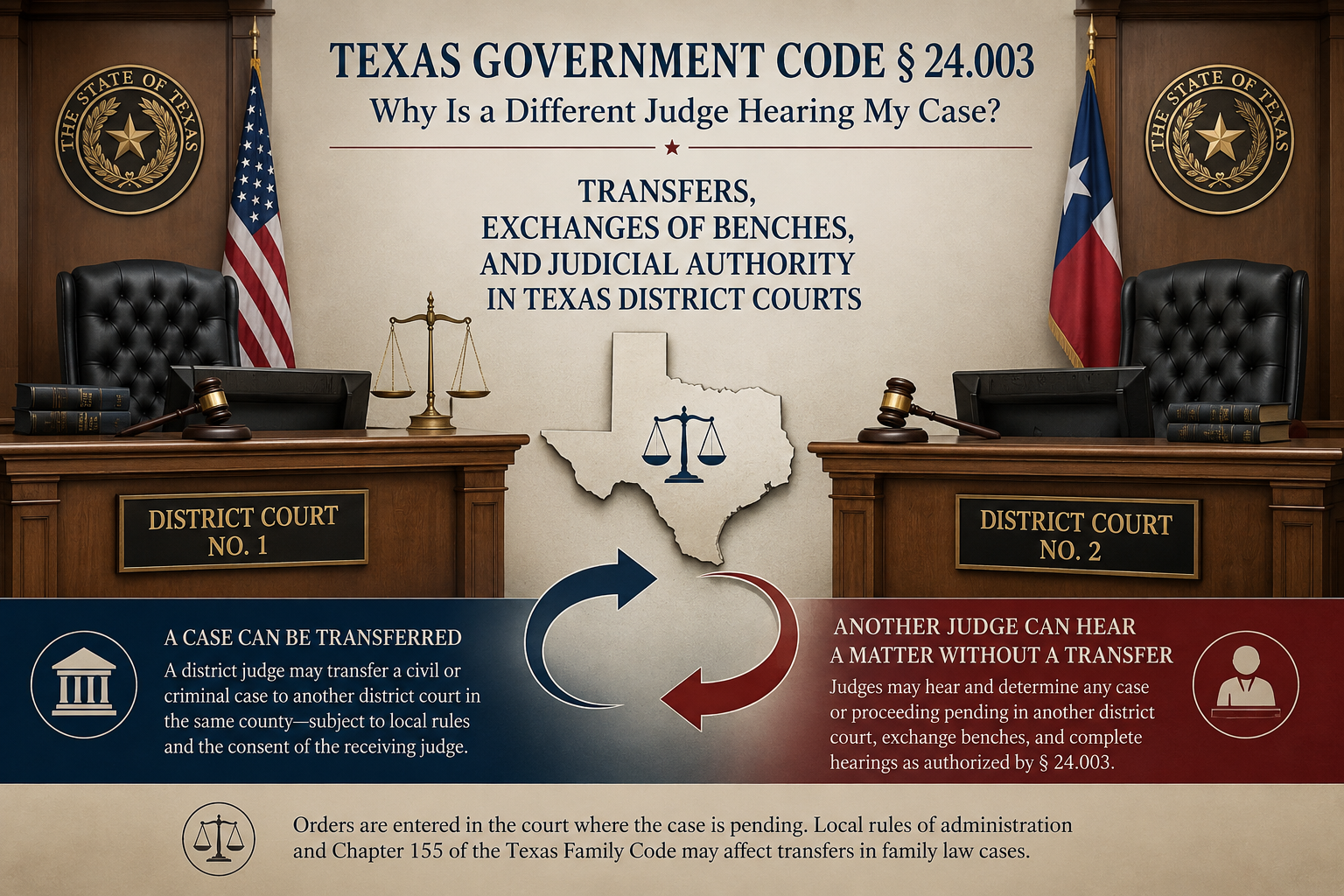
Texas law gives district judges considerable flexibility to assist one another, particularly in counties containing multiple district courts. One of the principal statutes governing this practice is Texas Government Code § 24.003, which addresses transfers of cases and exchanges of benches.
The distinction can be surprisingly important. A different judge may hear a motion—or even substantial portions of a case—without the lawsuit itself ever leaving the court in which it was originally pending.
Texas Government Code § 24.003 Applies in Counties With Multiple District Courts
Texas Government Code § 24.003(a) establishes the statute's basic scope:
“This section applies only to counties with two or more district courts.”
That makes the statute particularly relevant in Texas's larger counties, where numerous district courts may operate alongside one another.
Rather than requiring every matter assigned to a particular district court to be personally heard by that court's regular judge, the Government Code permits considerable judicial cooperation.
A Case Can Be Transferred to Another District Court
One possibility is an actual transfer of the case.
Under Texas Government Code § 24.003(b), subject to local rules of administration, a district judge may generally transfer a civil or criminal case or proceeding on the court's docket to another district court in the same county, with an exception for certain cases governed by Chapter 155 of the Texas Family Code.
There is an important limitation, however.
Section 24.003(b-1) provides:
“Notwithstanding the local rules of administration, a district judge may not transfer any civil or criminal case or proceeding to the docket of another district court without the consent of the judge of the court to which it is transferred.”
Thus, a judge generally cannot simply dump a case onto another district court's docket without that court's consent.
An actual transfer changes the court in which the case is pending. But that is not the only way another district judge can become involved.
Another Judge Can Hear the Case Without a Transfer
This is where Texas Government Code § 24.003 becomes especially interesting.
The statute expressly authorizes a district judge to:
“hear and determine any case or proceeding pending in another district court in the county without having the case transferred.”
That language creates an important distinction between the court in which the lawsuit is pending and the particular judge who happens to hear a matter in the lawsuit.
Those are not necessarily the same thing.
Suppose a civil lawsuit is pending in District Court A. The judge of District Court B may, under appropriate circumstances, hear a motion in that case without the clerk transferring the entire lawsuit onto District Court B's docket.
The lawsuit remains a case of District Court A.
Judge B is simply exercising statutory authority to hear a matter pending there.
Texas Judges Can Temporarily Exchange Benches
Section 24.003 goes further.
Among other things, it allows district judges to:
“temporarily exchange benches with the judge of another district court in the county.”
The statute also permits one district judge to “sit for another district court in the county and hear and determine” matters pending there.
This provides flexibility when courts encounter scheduling conflicts, crowded dockets, absences, recusals, or other administrative problems.
From a litigant's perspective, however, the arrangement can look strange.
The case number may still identify one district court while a different district judge conducts the hearing.
That does not, standing alone, establish that anything improper has occurred.
One Judge Can Start a Matter and Another Can Finish It
Texas Government Code § 24.003(d) provides even broader authority.
It states in part:
“A district judge in the county may hear and determine any part or question of any case or proceeding pending in any of the district courts, and any other district judge may complete the hearing and render judgment in the case or proceeding.”
That is a significant procedural rule.
Texas law does not necessarily require a single district judge to personally handle every intermediate question arising throughout a lawsuit.
The statute specifically contemplates judges handling different components of a case.
Section 24.003(d) identifies examples including:
- motions for new trial;
- petitions for injunction;
- applications for appointment of a receiver;
- interventions;
- pleas in abatement;
- dilatory pleas; and
- other preliminary matters and proceedings.
Accordingly, the identity of the judge hearing a particular motion does not necessarily determine which court actually possesses the case.
Injunctions Present an Especially Interesting Example
Section 24.003(d) also provides that:
“A district judge may issue a restraining order or injunction that is returnable to any other district court.”
This illustrates how flexible Texas's multi-court system can be.
Emergency litigation does not always fit neatly into ordinary scheduling arrangements. Temporary restraining orders and other emergency requests may require immediate judicial action.
The statute therefore provides mechanisms allowing judges within a county to address matters pending elsewhere without requiring the entire lawsuit to be formally transferred every time another judge becomes involved.
The Court and the Judge Are Not Always the Same Procedural Concept
For litigants, one of the most useful lessons from § 24.003 is conceptual.
A lawsuit belongs to a court, not personally to an individual judge.
The elected or regularly assigned judge ordinarily presides over that court, but Texas law provides numerous mechanisms through which another legally authorized judge may act for it.
That distinction helps explain situations that otherwise appear peculiar.
A docket may say that a case is pending in one district court. A hearing notice may identify the same court. Yet another district judge may appear and hear the motion.
The key question is not simply:
“Is this the regular judge?”
Instead, the legal question is whether the judge has lawful authority to act in the case.
Where Is an Order Entered When Another Judge Hears the Matter?
Section 24.003(e) answers another technical but important question:
“A judgment or order shall be entered in the minutes of the court in which the case is pending.”
That reinforces the distinction between the judge acting in the case and the court possessing the case.
If a judge from another district court hears a motion without a transfer, the resulting order does not thereby become an order of the visiting judge's regular court.
It remains an order entered in the case pending before the original court.
Transfer of a Case Is Different From Exchange of Benches
This distinction can be summarized relatively simply.
A transfer moves the case from the docket of one court to another.
An exchange of benches, or another judge hearing a matter under § 24.003, may change the judge who handles a proceeding without changing the court in which the lawsuit is pending.
The practical consequences can matter.
Court numbers, docket assignments, clerk records, subsequent hearings, local administrative rules, and future filings may all depend upon identifying the court in which the case actually remains pending.
A lawyer therefore should not assume that the appearance of a different judge means that the lawsuit has been transferred.
Local Rules Still Matter
Section 24.003 does not operate in isolation.
The statute itself recognizes the importance of local rules of administration.
Texas Government Code § 24.024 separately provides:
“In a county with two or more district courts, the district judges may adopt rules governing the filing and numbering of cases, the assignment of cases for trial, and the distribution of the work of the courts as in their discretion they consider necessary or desirable for the orderly dispatch of the business of the courts.”
Thus, understanding why a particular judge is hearing a particular case may require examining both statewide law and the applicable county's local administrative system.
Large counties may have sophisticated systems for docket assignment and distribution of judicial work that are not obvious merely from looking at the style of a lawsuit.
Family Law Has an Important Limitation
Family lawyers should pay particular attention to the statutory exception involving Texas Family Code Chapter 155.
Chapter 155 concerns continuing, exclusive jurisdiction and transfer in suits affecting the parent-child relationship.
Section 24.003 does not simply override those specialized family-law transfer provisions.
That distinction makes sense because transferring a SAPCR involving continuing, exclusive jurisdiction raises issues beyond ordinary docket administration.
Consequently, attorneys should distinguish between a judge temporarily hearing a matter and an attempt to transfer a family-law case in a manner governed by the Family Code.
Can You Object Merely Because a Different Judge Appears?
Not necessarily.
The fact that a different district judge is hearing the matter does not by itself mean that the judge lacks authority.
Section 24.003 expressly contemplates judges hearing cases pending in other district courts and exchanging benches.
That does not mean every judicial assignment is immune from challenge. Different rules govern matters such as constitutional disqualification, recusal, assigned judges, visiting judges, and particular statutory restrictions.
But an objection based solely on the proposition that “this isn't the judge whose court number appears on my case” may overlook the authority granted by the Government Code.
The actual procedural circumstances must be examined.
Why This Matters in Texas Litigation
Texas Government Code § 24.003 is the kind of statute that rarely attracts public attention but can become extremely important when a litigant encounters it in an actual lawsuit.
It explains why:
- a different district judge may hear a motion;
- a judge may sit for another court;
- district judges may exchange benches;
- one judge may begin a proceeding and another may complete it;
- certain matters can be heard without formally transferring the lawsuit; and
- orders remain entered in the court where the case is actually pending.
The statute is ultimately designed to prevent the administration of justice from becoming unnecessarily rigid.
Texas has many counties with multiple district courts handling enormous numbers of civil, family, and criminal cases. Allowing judges to cooperate helps those courts address scheduling problems and distribute judicial work.
The Bottom Line
Seeing an unfamiliar judge at a Texas court hearing does not necessarily mean your case has been transferred or that something has gone wrong.
Texas Government Code § 24.003 expressly allows district judges in counties with multiple district courts to hear matters for one another, sit for other courts, exchange benches, and—in appropriate circumstances—transfer cases between district courts.
The critical distinction is between transferring the lawsuit itself and allowing another judge to exercise authority in a lawsuit that remains pending in its original court.
That distinction may sound technical, but procedural details often matter enormously in litigation. When questions arise about which judge is hearing a case, which court actually possesses it, or whether a transfer has occurred, the Government Code, applicable local rules, and the particular court records should all be examined carefully.
This article is for general informational purposes only and does not constitute legal advice. Court administration and judicial-assignment issues can depend on the particular county, court, case type, and procedural history.
At David C. Barsalou, Attorney at Law, PLLC, we help clients navigate business, family, tax, estate planning, and real estate matters ranging from document drafting to litigation with clarity and confidence. If you’d like guidance on your situation, schedule a consultation today. Call us at (713) 397-4678, email barsalou.law@gmail.com, or reach us through our Contact Page. We’re here to help you take the next step.