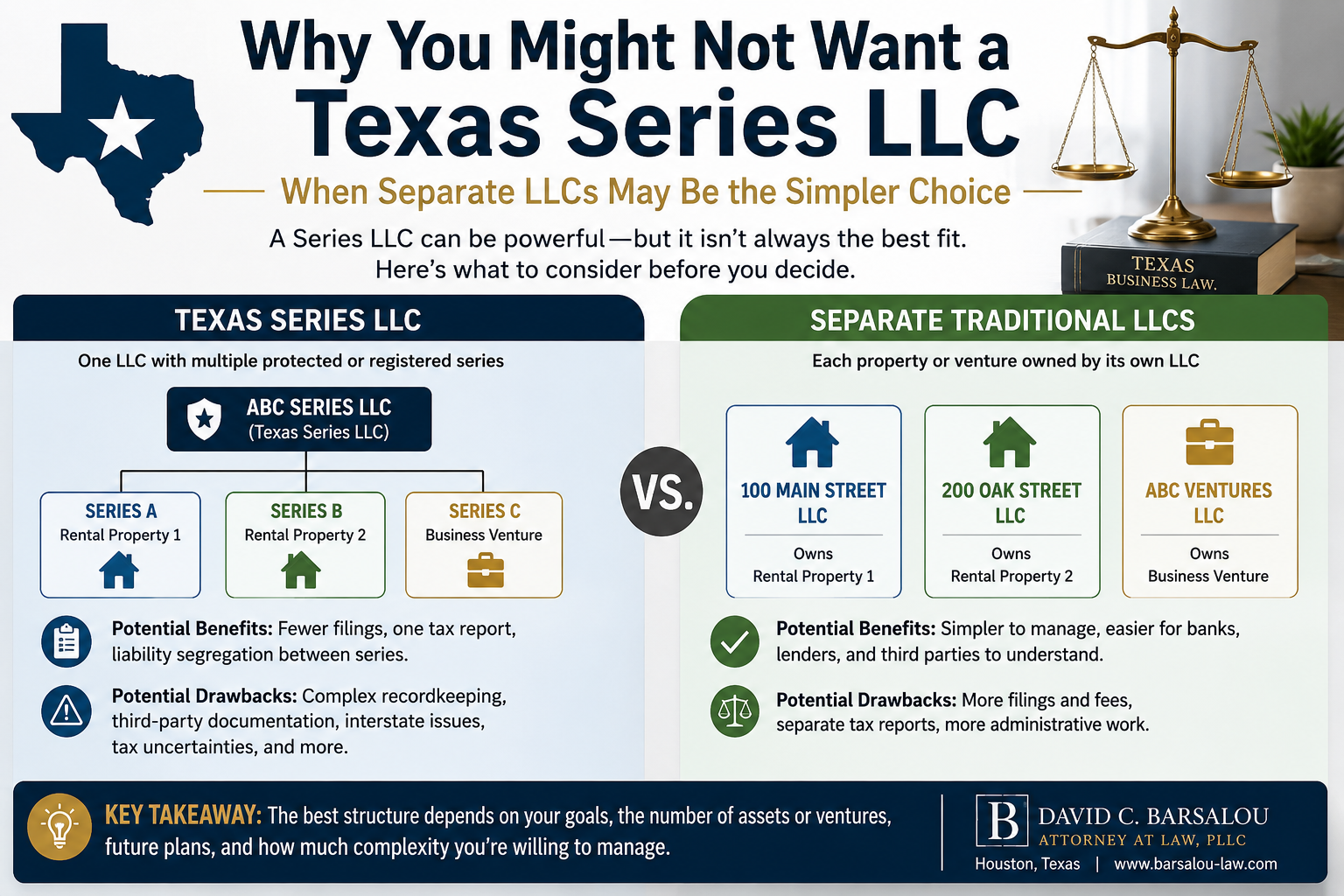
A Texas Series LLC can look extremely attractive on paper.
Instead of forming a separate limited liability company for every rental property, investment, or business venture, an owner can form a single Series LLC and establish individual series within it. Texas law allows each protected or registered series to have separate rights, powers, duties, business purposes, and assets.
When properly structured and maintained, Texas law also provides for segregation of liabilities among the series.
For an entrepreneur with numerous similar assets or ventures, that can offer substantial organizational advantages.
But there is another question worth asking:
When is a Series LLC more complicated than it is worth?
The answer is not that Series LLCs are inherently bad. They are not. The problem is that the principal advantage of a Series LLC—placing multiple liability compartments within a single organizational structure—can also introduce legal, accounting, transactional, and administrative questions that do not arise when each venture simply operates through its own conventional LLC.
In some situations, a Series LLC may be an excellent choice.
In others, several boring, ordinary LLCs may actually be easier.
1. The Liability Segregation Requires the Structure to Be Properly Maintained
One of the principal attractions of a Series LLC is the ability to segregate liabilities.
Texas Business Organizations Code § 101.602 provides the statutory framework under which debts, liabilities, obligations, and expenses associated with a particular protected or registered series may be enforceable only against the assets of that series rather than against the assets of the LLC generally or another series.
But that protection does not arise simply because an owner calls something “Series A.”
Section 101.602 imposes statutory requirements for the limitation on liability to apply. Among other things, records maintained for a particular series must account for the assets associated with that series separately from the other assets of the company or another series. The certificate of formation and company agreement must also contain the notices and provisions required by statute.
The Texas Secretary of State similarly cautions that, to receive the benefits of a Series LLC, the required language must be included in the certificate of formation and company agreement and separate records must be maintained for the assets of each series.
That creates an important practical point.
A Series LLC may reduce the number of entities being formed, but it does not eliminate the need for meaningful internal separation.
If Series A owns one rental property and Series B owns another, the owner should not treat the two as an undifferentiated pile of assets merely because they exist beneath the same LLC.
Could Another Entity Structure Solve This Problem?
Yes: separate conventional LLCs.
Instead of:
ABC Properties LLC
- Series A – 100 Main Street
- Series B – 200 Oak Street
- Series C – 300 Pine Street
the investor could form:
100 Main Street LLC
200 Oak Street LLC
300 Pine Street LLC
Separate LLCs still require proper books, records, accounts, and business formalities. They do not excuse sloppy administration.
But the organizational distinction is obvious.
There is much less conceptual ambiguity about which entity owns 100 Main Street when the deed, bank account, insurance policy, lease, and contracts all identify 100 Main Street LLC.
For an owner with only a handful of significant assets, that simplicity may be worth the additional filing and administrative costs.
2. A Series Is Not Simply Another Standalone Texas LLC
Texas law now expressly distinguishes between a protected series and a registered series.
A protected series generally exists through the governing structure of the Series LLC without a separate certificate of registered series being filed with the Secretary of State.
A registered series, by contrast, is evidenced by a certificate of registered series filed with the Secretary of State.
But neither is simply an independent domestic LLC.
Texas Business Organizations Code § 101.622 provides that a protected or registered series is not a separate domestic entity or organization for purposes of Title 1 and Chapter 101 of the Business Organizations Code.
That distinction can matter because business owners sometimes conceptualize a Series LLC as a collection of completely independent LLCs sitting beneath a parent.
That is an easy mental picture, but it is not quite what Texas law creates.
Could Another Entity Structure Solve This Problem?
Yes: a parent LLC with separately formed subsidiary LLCs.
For example:
ABC Holdings LLC
↓
100 Main Street LLC
200 Oak Street LLC
300 Pine Street LLC
Now each subsidiary actually is a separately formed LLC.
This structure may be attractive when the owner wants centralized ownership or management but also wants each operating or property-owning company to have an ordinary standalone legal identity.
It costs more to create and maintain multiple entities, but it may produce a structure that is easier for lenders, purchasers, title companies, insurers, accountants, and other third parties to understand.
3. Protected Series Can Present a Documentation Problem With Third Parties
The distinction between protected and registered series becomes particularly interesting when the business deals with outsiders.
A registered series requires an additional filing with the Texas Secretary of State. That filing currently carries a $300 filing fee.
Why would someone pay to register a series when Texas permits protected series?
One answer is documentation.
The Secretary of State explains that because a registered series has a filing on record, it can obtain a certificate of status for presentation to third parties and can file other instruments reflecting changes involving that series.
A protected series does not have the same separate public filing establishing its existence.
That may not matter when the business is simply operating internally.
It may matter considerably when a bank, lender, title company, purchaser, or other third party wants documentary evidence concerning the business with which it is dealing.
Could Another Entity Structure Solve This Problem?
Yes: a registered series can partially solve it, and a standalone LLC can solve it more conventionally.
This is an interesting instance in which the alternative does not necessarily require abandoning the Series LLC.
If the owner likes the Series LLC structure but anticipates substantial dealings with third parties, using a registered seriesrather than merely a protected series may make documentation easier.
But there is a tradeoff: the certificate of registered series itself costs $300 to file.
At that point, the owner should at least compare the registered-series structure with simply forming another LLC, for which the Texas certificate-of-formation filing fee is also $300.
The registered series may still have other advantages as part of the larger Series LLC structure. But the filing-cost advantage becomes less obvious when each important series is separately registered.
4. Series LLCs Can Create More Complicated Contracting Questions
Suppose an ordinary LLC owns an apartment building.
A contract identifies:
Oak Apartments LLC
The company signs the contract. The company's assets and liabilities are generally identifiable. There is relatively little mystery about which organization is the contracting party.
Now suppose the property belongs to a particular series.
The documents need to properly identify the relevant series. Assets need to be associated with the correct series. Contracts should be entered into by the proper party. The individual signing should have appropriate authority.
None of those problems is insurmountable.
Indeed, Texas law expressly permits individual series to contract, hold title to assets, grant liens and security interests, and sue or be sued.
But a legal structure does not have to be defective to be inconvenient.
Every additional explanation, document, and opportunity to identify the wrong party is an additional source of transactional friction.
Could Another Entity Structure Solve This Problem?
Yes: a standalone LLC for each important operating business or asset.
If Oak Apartments LLC owns Oak Apartments, the transactional structure is immediately apparent.
This can be especially attractive when an asset will frequently interact with lenders, investors, purchasers, tenants, contractors, insurers, or title companies.
A Series LLC may work perfectly well in those situations.
The question is whether the efficiencies produced by the series structure are valuable enough to justify making an otherwise simple ownership structure less conventional.
5. A Series LLC May Be Less Attractive When the Business Will Operate Outside Texas
A business organized in Texas does not necessarily remain in Texas.
It may acquire property elsewhere, establish offices elsewhere, employ people elsewhere, or enter another state's market.
The problem is that Series LLC statutes are not uniform throughout the United States.
The Texas Secretary of State expressly warns that not every state recognizes Series LLCs and recommends determining whether another state recognizes the structure and what filing requirements apply before transacting business there.
This does not mean a Texas Series LLC cannot operate outside Texas.
It means that one of its principal attractions—the statutory series structure created under Texas law—may require additional analysis whenever the business crosses jurisdictional lines.
Could Another Entity Structure Solve This Problem?
Often, yes: conventional LLCs can reduce the issue.
Ordinary LLCs are familiar throughout the United States.
A Texas company acquiring substantial property in another state might also consider forming an entity under that state's law, depending on the circumstances.
For example, an investor buying ten Texas rental properties and expecting to remain entirely in Texas presents a different Series LLC candidate from an entrepreneur expecting to acquire businesses and real estate in six states.
The more interstate the operation becomes, the more valuable structural familiarity may become.
6. State Organizational Treatment and Federal Tax Treatment Are Not Necessarily the Same Thing
Another source of potential confusion is taxation.
For Texas franchise-tax purposes, the Comptroller treats a Series LLC as a single legal entity. The Series LLC files one franchise tax report and one Public Information Report under a single Texas taxpayer identification number.
That is a genuine administrative advantage.
But federal taxation involves a different body of law.
The IRS has addressed Series LLCs through proposed federal tax regulations concerning how individual series may be classified for federal tax purposes. Those proposed regulations contemplate treating a series as an entity formed under local law for federal classification purposes and then applying the ordinary federal entity-classification principles.
The important practical lesson is not that Series LLC taxation is necessarily unfavorable.
It is that:
“One LLC under Texas law” does not automatically answer every federal tax question involving the series beneath it.
The organizational-law structure and federal tax classification analysis are separate questions.
Could Another Entity Structure Solve This Problem?
Potentially: conventional LLCs may make the entity-classification analysis more familiar, but they do not eliminate federal tax classification issues.
A single-member LLC, multi-member LLC, partnership, S corporation, and C corporation can all produce different federal tax consequences depending on ownership and elections.
Separate LLCs therefore do not magically make taxation simple.
What they can do is place the taxpayer in a much more familiar entity framework.
If tax simplicity is a major objective, the owner should decide on the desired federal tax treatment first and then determine whether a Series LLC actually advances that objective.
The tax tail should not wag the organizational dog.
7. Texas Franchise-Tax Simplicity Comes With a Tradeoff
Texas's treatment of Series LLCs creates one of the strongest arguments in favor of the structure.
The Comptroller treats the Series LLC as one legal entity for franchise-tax purposes.
One Texas taxpayer number. One franchise tax report. One Public Information Report.
For an investor with a large number of series, that can be a meaningful administrative benefit.
There is, however, another side to the rule.
The Comptroller states that if one series has nexus in Texas, the entire Series LLC has nexus in Texas.
This illustrates a recurring feature of Series LLCs: sometimes the law treats the individual series separately, and sometimes it treats the overall LLC as the relevant unit.
Could Another Entity Structure Solve This Problem?
Yes: separate LLCs preserve separate entity-by-entity analysis.
That does not necessarily produce a better tax result. In fact, it can create considerably more filing work.
But if an owner specifically wants completely independent entities with separate ownership, operations, reporting obligations, or geographic footprints, conventional LLCs may fit that objective better than compartments within a single Series LLC.
This is another situation in which the supposed disadvantage of separate LLCs—their separateness—is sometimes exactly what the owner wants.
8. A Series LLC May Be Awkward If You Expect to Sell Individual Businesses or Bring in Different Owners
Imagine an entrepreneur creates four unrelated businesses within four series.
Five years later:
- one business is sold;
- a new investor buys 30 percent of another;
- a third takes on significant debt; and
- the fourth remains wholly owned by the original entrepreneur.
Texas Series LLC law provides considerable flexibility concerning the rights, powers, duties, assets, and membership associated with particular series.
The structure can accommodate complexity.
But the question should again be whether accommodating complexity is better than avoiding it.
If the owner knows from the beginning that each venture may eventually have different investors, financing, management, or exit strategies, separately formed entities may provide cleaner transactional units.
Could Another Entity Structure Solve This Problem?
Yes: separate subsidiary LLCs may be particularly useful.
A holding company can own several subsidiary LLCs.
An investor can later acquire an interest in one subsidiary without necessarily acquiring an interest in the others.
One subsidiary can potentially be sold as its own entity.
Different operating agreements can govern different subsidiaries.
Different financing can remain associated with different entities.
Again, a properly designed Series LLC may accomplish many of the owner's objectives.
But if the long-term plan already contemplates treating the ventures as genuinely independent businesses, forming genuinely independent entities at the beginning deserves serious consideration.
9. The Cost Savings Matter More at Scale
Perhaps the best way to understand the Series LLC decision is to compare two hypothetical investors.
Investor One: Three Rental Houses
Rachel owns three rental properties.
She could establish:
Rachel Properties LLC
- Oak Street Series
- Pine Street Series
- Main Street Series
Or she could simply create:
Oak Street LLC
Pine Street LLC
Main Street LLC
The Series LLC may save formation costs and consolidate certain Texas administrative obligations.
But with only three properties, Rachel may reasonably decide that the simplicity of three conventional entities is worth paying for.
Investor Two: Seventy-Five Rental Properties
Now imagine Michael owns 75 rental properties and intends to continue acquiring them.
Creating, maintaining, and administering 75 separate Texas LLCs is a very different proposition.
The Series LLC begins to look considerably more attractive because its administrative efficiencies can operate at scale.
That reveals something important about the Series LLC.
The structure's benefits may increase as the number of ventures or assets increases.
The question is therefore not merely whether the Series LLC works.
It is whether the owner has enough complexity to justify using a structure designed to manage complexity.
10. Sometimes the Boring Structure Is Better
Business owners understandably like efficiency.
If ten assets can be organized beneath one LLC rather than ten, the Series LLC immediately sounds attractive.
But legal structures should not be judged solely by the number of formation documents filed with the Secretary of State.
There are other forms of cost:
- accounting complexity;
- recordkeeping requirements;
- banking complications;
- title and lending questions;
- contract administration;
- tax classification;
- interstate operations;
- investor relations; and
- the possibility of mistakes when assets and liabilities must consistently be associated with the proper series.
A conventional LLC is boring.
Sometimes boring is excellent.
If an entrepreneur owns three substantial and unrelated businesses, three conventional LLCs may be easier for the owner, accountant, bank, insurer, lawyer, lender, purchaser, and eventual investor to understand.
If the same entrepreneur owns 75 similar assets and needs an efficient mechanism for segregating them, a Series LLC may become considerably more compelling.
Choosing Among a Series LLC, Registered Series, Separate LLCs, and a Holding-Company Structure
There is no universal winner.
A Series LLC with protected series may make sense when an owner wants numerous liability compartments while minimizing separate state filings.
A Series LLC with registered series may make sense when the owner wants the series structure but also wants a public filing and the ability to obtain a certificate of status for particular series.
Separate standalone LLCs may make sense when there are relatively few important assets or ventures and simplicity, independent identity, interstate familiarity, financing, or eventual sale is particularly important.
A holding company with separate subsidiary LLCs may make sense when the owner wants centralized ownership while preserving conventional, separately formed entities for individual businesses or assets.
The cheapest structure to form is not necessarily the cheapest structure to operate.
And the most sophisticated structure is not necessarily the best one.
Bottom Line
Texas Series LLCs solve a real problem.
Texas Business Organizations Code Chapter 101 allows an LLC to establish protected or registered series and, when the statutory requirements are satisfied, provides a mechanism for segregating liabilities associated with those series.
For the right business, particularly one involving numerous similar assets or ventures, that can be extremely useful.
But the Series LLC should not be selected merely because it appears to provide several LLCs for the price of one.
A business owner should ask a different set of questions:
How many assets or ventures will there actually be?
Will they have different owners?
Will individual ventures eventually be sold?
Will lenders or outside investors become involved?
Will the company operate outside Texas?
How important is having conventional documentation for banks, title companies, insurers, and contracting parties?
And, perhaps most importantly:
Is the Series LLC eliminating enough administrative work to justify the additional structural complexity it creates?
Sometimes the answer will be yes.
Sometimes the better answer is simply to form another LLC.
For Texas business owners, the goal should not be to select the most elaborate entity structure available. It should be to select the simplest structure that reliably accomplishes the business owner's actual legal, tax, operational, and liability-protection objectives.
At David C. Barsalou, Attorney at Law, PLLC, we help clients navigate business, family, tax, estate planning, and real estate matters ranging from document drafting to litigation with clarity and confidence. If you’d like guidance on your situation, schedule a consultation today. Call us at (713) 397-4678, email barsalou.law@gmail.com, or reach us through our Contact Page. We’re here to help you take the next step.