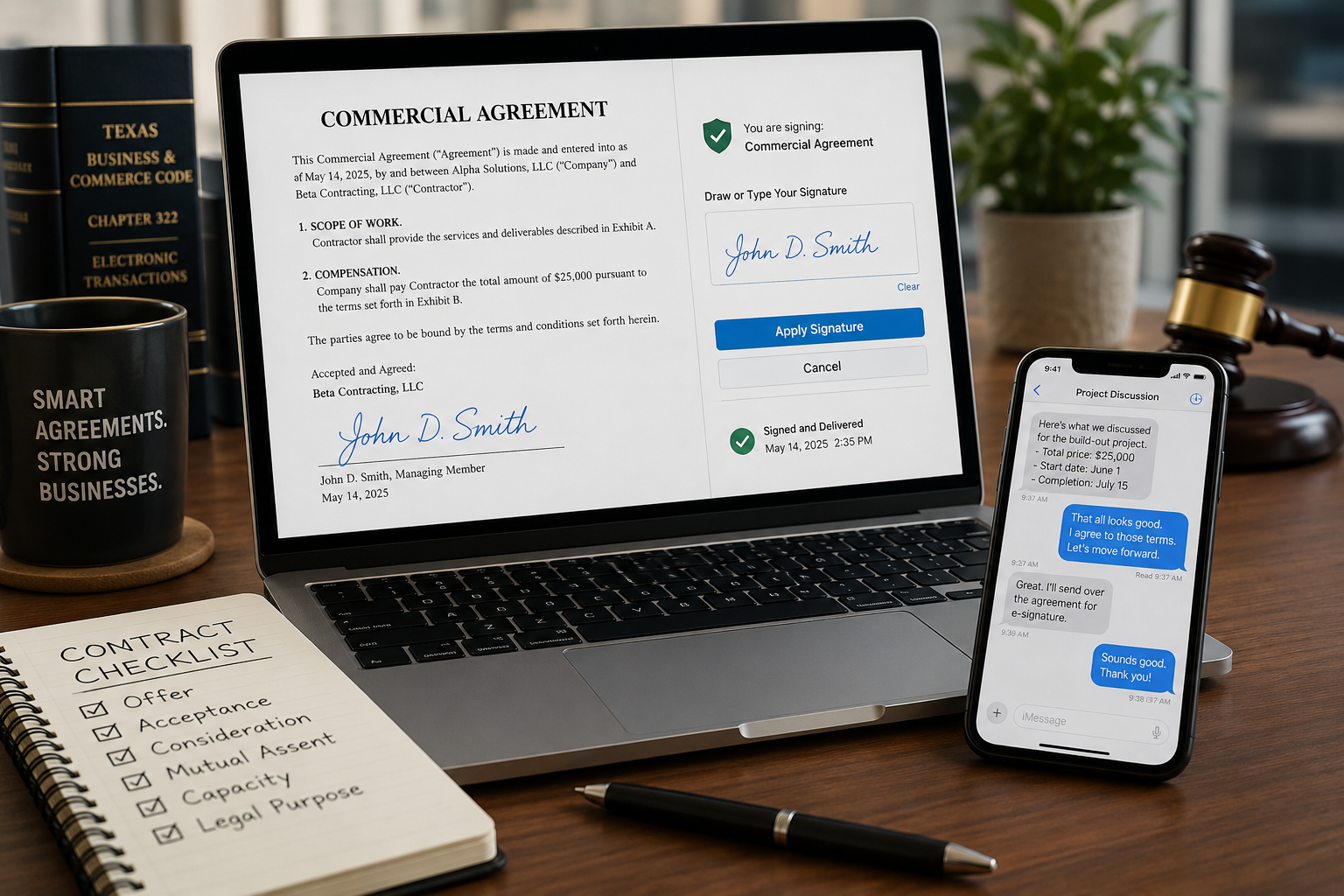
Modern business often happens over text messages, emails, and electronic documents rather than across a conference table. Many Texans assume that a contract is not enforceable unless it contains a handwritten signature. Surprisingly, that is often incorrect.
Texas has adopted the Uniform Electronic Transactions Act ("UETA"), found in Chapter 322 of the Texas Business and Commerce Code, which gives electronic signatures and records the same legal effect as their paper counterparts in many transactions.
For businesses, landlords, real estate professionals, and individuals negotiating contracts, understanding UETA can prevent costly disputes over whether a deal was actually finalized.
What Is an Electronic Signature?
The Texas Business and Commerce Code broadly defines an electronic signature.
Section 322.002(8) provides:
"Electronic signature" means an electronic sound, symbol, or process attached to or logically associated with a record and executed or adopted by a person with the intent to sign the record.
This definition is intentionally broad. An electronic signature may include:
- Clicking "I Accept"
- Typing your name at the end of an email
- Signing with a finger on a tablet
- Using DocuSign or Adobe Sign
- A digitally authenticated signature
- In some circumstances, even conduct demonstrating an intent to authenticate an electronic record
The important question is not how the signature appears—it is whether the person intended to sign the document.
Texas Gives Electronic Signatures Legal Effect
Perhaps the most important provision appears in Texas Business and Commerce Code § 322.007, which states:
"A record or signature may not be denied legal effect or enforceability solely because it is in electronic form."
Likewise,
"A contract may not be denied legal effect or enforceability solely because an electronic record was used in its formation."
This language reflects an important policy choice. Texas law generally treats electronic contracts the same as paper contracts.
Emails Can Form Binding Contracts
One surprisingly common situation involves negotiations conducted entirely through email.
Suppose two businesses exchange emails agreeing on:
- the purchase price,
- the property,
- delivery terms, and
- payment.
If both parties intend to be bound, those emails may satisfy the signature requirement under Texas law.
The fact that nobody physically signed a sheet of paper does not automatically defeat the agreement.
Of course, every contract still requires the traditional elements of contract formation—including offer, acceptance, consideration, and mutual assent.
Can Text Messages Create Contracts?
Sometimes.
Courts increasingly recognize that text messages may constitute evidence of:
- acceptance,
- modification,
- settlement agreements,
- acknowledgments of debt, or
- other contractual promises.
Whether a particular text creates an enforceable agreement depends upon the facts, including:
- whether the parties intended to enter a binding agreement,
- whether all essential terms were agreed upon,
- whether additional documentation was contemplated,
- whether a statute requires something more.
Many business disputes today involve screenshots rather than ink.
Not Every Transaction Is Covered
UETA does not apply to every possible transaction.
Certain areas of law remain governed by separate statutes or have specific execution requirements. For example, wills generally require compliance with the Texas Estates Code rather than relying solely upon UETA.
Likewise, some real estate transactions involve recording requirements, acknowledgments, or other statutory formalities beyond merely signing a contract electronically.
Intent Is Still Everything
One misconception is that clicking a button automatically creates an enforceable contract.
Intent remains central.
If someone accidentally clicks "Accept," or if the surrounding circumstances show that negotiations were still ongoing, a court may conclude that no final agreement was reached.
Likewise, merely sending draft documents back and forth does not necessarily establish mutual assent.
Electronic signatures eliminate the paper—not the legal requirements for contract formation.
Practical Tips for Businesses
Businesses can reduce litigation by:
- Clearly stating when negotiations become binding.
- Using reputable electronic signature platforms.
- Maintaining complete electronic records.
- Preserving emails and text messages.
- Including integration clauses in final agreements.
- Avoiding informal "we'll work out the details later" language if immediate enforceability is intended.
Small procedural steps today often prevent expensive litigation tomorrow.
Why This Matters
Electronic contracting has become the ordinary way business is conducted. Texas law recognizes this reality by giving electronic records and signatures the same legal effect as traditional paper documents in most circumstances.
The real legal question is usually no longer "Was it signed with ink?"
Instead, the question is often:
"Did the parties objectively intend to enter into a binding agreement?"
Understanding that distinction can make the difference between an enforceable contract and an expensive lawsuit.
At David C. Barsalou, Attorney at Law, PLLC, we help clients navigate business, family, tax, estate planning, and real estate matters ranging from document drafting to litigation with clarity and confidence. If you’d like guidance on your situation, schedule a consultation today. Call us at (713) 397-4678, email barsalou.law@gmail.com, or reach us through our Contact Page. We’re here to help you take the next step.