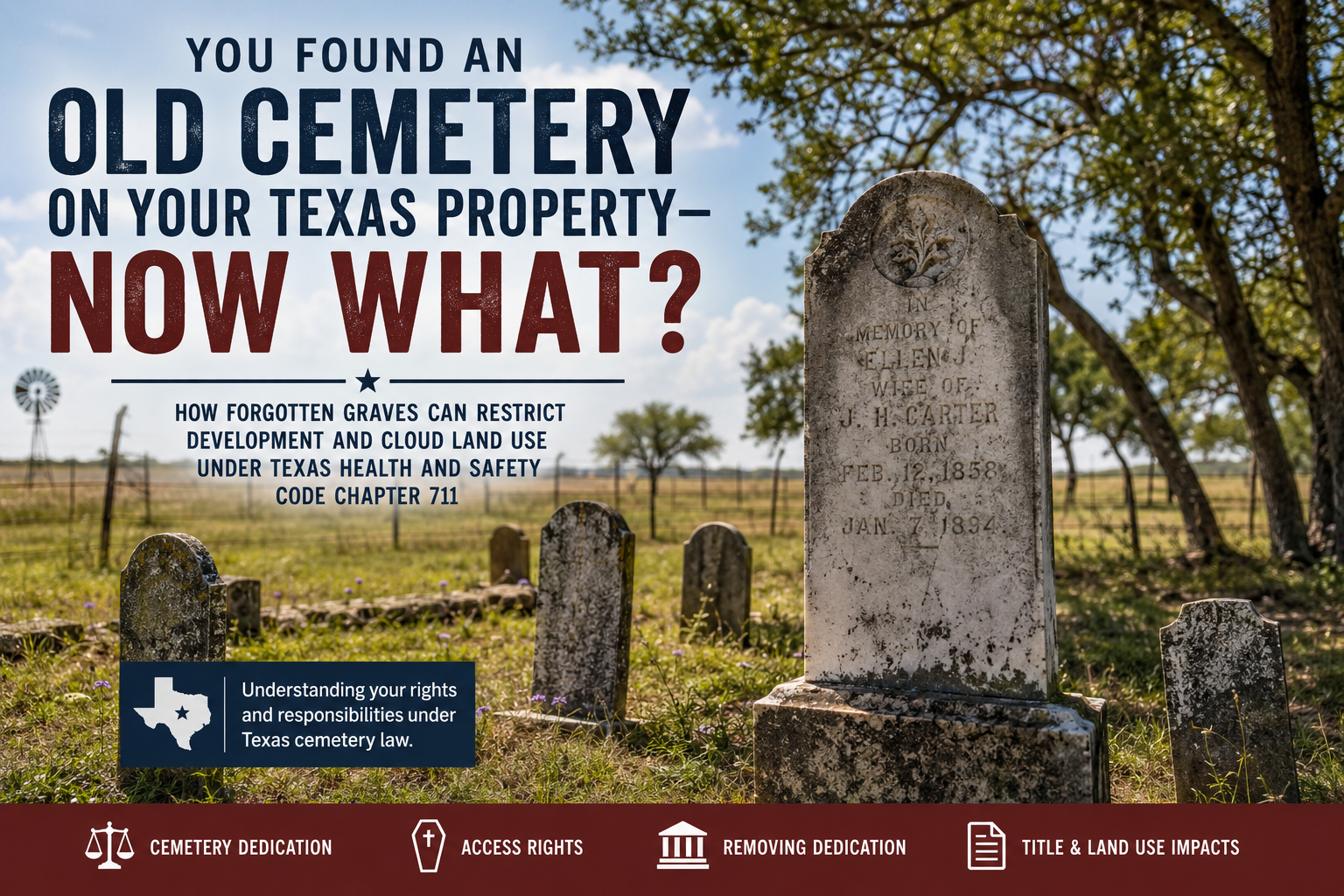
Buying several acres of Texas land can come with plenty of surprises: an undisclosed easement, an old pipeline, a boundary discrepancy, or perhaps a neighbor who has been using a dirt road across the property for the last thirty years.
One of the stranger possibilities is considerably harder to solve:
There may be people buried on the property.
Texas contains countless old family cemeteries, rural graveyards, abandoned cemeteries, and burial sites that predate modern subdivisions and development. Some may not be obvious from a casual inspection of the deed records. Others may consist of only a few graves surrounded by property that has changed hands many times.
Discovering one can create a significant legal problem for an owner, buyer, developer, lender, or title company.
Texas Health and Safety Code Chapter 711 gives cemeteries a remarkably durable legal status. In some circumstances, finding even one human burial can substantially restrict what can be done with that portion of the property.
Texas Law Can Treat Land as Cemetery Property Because a Burial Is Actually There
One of the most important provisions is Texas Health and Safety Code § 711.035.
The statute provides:
“Property is considered to be dedicated cemetery property if: (1) one or more human burials are present on the property.”
Tex. Health & Safety Code § 711.035(g)(1).
Alternatively, property qualifies if a dedication of the property for cemetery use has been recorded in the county deed records. Tex. Health & Safety Code § 711.035(g)(2).
That distinction can be extremely important in a real-estate transaction.
Ordinarily, a buyer's title investigation focuses heavily on recorded documents: deeds, liens, easements, restrictive covenants, judgments, plats, and other instruments affecting title.
A cemetery presents a different problem.
The physical existence of human burials may itself trigger the statute.
Consequently, the absence of a recorded document labeled “cemetery” does not necessarily mean that the property is free from cemetery-related restrictions.
Cemetery Dedication Is Extremely Difficult to Extinguish
Section 711.035 makes cemetery dedication unusually durable.
Texas law expressly provides that dedication of cemetery property is not affected by dissolution of the cemetery organization, nonuse, alienation, encumbrance, or forced sale. Tex. Health & Safety Code § 711.035(b).
That means several events that might ordinarily cause someone to assume that an old property restriction has disappeared do not necessarily eliminate cemetery status.
For example, suppose a family established a small cemetery on a 100-acre tract generations ago. The family later sold the property. The land changed hands several more times, and eventually a developer acquired it.
The fact that the surrounding acreage has been bought and sold does not, standing alone, make the cemetery disappear legally.
Indeed, § 711.035(f) provides:
“Dedicated cemetery property shall be used exclusively for cemetery purposes until the dedication is removed by court order…”
Tex. Health & Safety Code § 711.035(f).
For developers and purchasers, that is the critical point.
Buying the land does not necessarily give the buyer the ability to redevelop the cemetery portion of it.
A Cemetery Can Become a Development Problem
Imagine a developer purchasing 40 acres for a residential subdivision.
During clearing operations, workers discover several old headstones beneath heavy vegetation. Further investigation suggests that the area was once a small family burial ground.
The developer may suddenly have several problems.
The burial site may constitute dedicated cemetery property. Construction in the affected area may therefore be restricted. The discovery may require notices or additional investigation. Access rights may have to be considered. And eliminating the cemetery dedication may require judicial proceedings rather than merely recording another document.
Texas law even restricts certain infrastructure from crossing dedicated cemetery property. Section 711.035(d) provides that a railroad, street, road, alley, pipeline, telephone or electric line, wind turbine, cellular tower, or other public utility or thoroughfare may not be placed through, over, or across part of a dedicated cemetery without the statutorily required consent.
Thus, a forgotten cemetery can affect considerably more than the precise square footage occupied by headstones.
It can interfere with the design of roads, utilities, drainage plans, lot configurations, and other improvements.
What If Nobody Even Knew the Cemetery Existed?
Chapter 711 specifically contemplates that cemeteries can be forgotten.
Texas law defines an “abandoned cemetery” to include a cemetery that is not owned or operated by a cemetery organization, has no other person legally responsible for its care, and is not maintained by anyone. Tex. Health & Safety Code § 711.001.
Section 711.011 then creates a reporting procedure when an unknown or abandoned cemetery is discovered.
A person discovering one generally must file notice with the county clerk and concurrently mail notice to the record landowner not later than the tenth day after discovery. The notice must include a legal description of the land and describe the approximate location and evidence of the cemetery. Tex. Health & Safety Code § 711.011(a).
The county clerk then sends a copy to the Texas Historical Commission and files the notice in the county deed records. Tex. Health & Safety Code § 711.011(c).
In other words, discovering forgotten graves can turn a physical condition on the property into a matter reflected in the public real-property records.
What About a Site That Might Be a Cemetery?
Sometimes the evidence is ambiguous.
A landowner might find depressions in the ground, deteriorated markers, archaeological evidence, or historical records suggesting burials without having confirmation that human remains are actually present.
Texas law has a separate concept for this situation: the “unverified cemetery.”
Under § 711.0111, a person discovering an unverified cemetery files notice and supporting evidence with the Texas Historical Commission and provides a copy to the landowner. The landowner may submit a response, after which the Commission evaluates whether sufficient evidence supports the existence of a cemetery.
This procedure matters because merely suspecting that graves exist and confirming that graves exist are legally different situations.
For a purchaser or developer, however, either can justify stopping work long enough to determine exactly what has been discovered.
Can the Graves Simply Be Moved?
Not necessarily.
Removal of human remains is separately regulated by Texas Health and Safety Code § 711.004, and removal of the cemetery dedication itself is addressed by § 711.036.
For an established cemetery organization, § 711.036(a) allows it to petition the district court in the county where the cemetery is located to remove the dedication from all or part of the property if either:
- all remains have been removed from the portion for which removal of the dedication is requested; or
- no interments occurred in that portion and it is not used or necessary for interment purposes.
Texas law also addresses the particularly difficult situation in which a cemetery no longer has a functioning cemetery organization or governing body.
An owner of land adjacent to such a cemetery may petition the appropriate district court to remove human remains and the dedication from all or part of the cemetery. Tex. Health & Safety Code § 711.036(b).
The court may consult the Texas Historical Commission and county historical commission, and unknown next of kin must be served through publication. The statute also requires a reasonable good-faith effort to remove the remains and monuments.
Most importantly, § 711.036(c) states that the court orders removal upon satisfactory notice and proof that:
“the removal is in the public interest.”
Tex. Health & Safety Code § 711.036(c).
That is much different from simply deciding that another use of the land would be more profitable.
Cemetery Access Can Affect the Surrounding Property Too
Even when the cemetery itself remains untouched, the owner of the surrounding land may face another unusual property issue: access.
Texas Health and Safety Code § 711.041 gives a person wishing to visit a cemetery or private burial ground without public ingress or egress a right to reasonable access for cemetery visitation.
The surrounding landowner generally may designate reasonable routes and hours of access. The statute also contains a procedure involving advance written notice for visits outside the hours established by the landowner.
This can matter enormously when purchasing rural acreage.
A small cemetery in the middle of a large tract may affect not merely the cemetery parcel but also the owner's practical ability to control access across the surrounding property.
The Texas Historical Commission likewise advises that § 711.041 prevents surrounding landowners from simply denying cemetery access.
Why This Matters During a Texas Real Estate Purchase
A cemetery issue illustrates why physical inspection and title review serve different purposes.
A title search may reveal a recorded cemetery dedication.
A survey might reveal a marked cemetery.
Historical research might reveal a cemetery that no longer has obvious markers.
And sometimes physical inspection of the property itself reveals something that none of the paperwork made apparent.
For buyers acquiring undeveloped or historically occupied acreage, particularly rural property, old burial sites should therefore be treated as more than curiosities.
They can represent genuine legal restrictions on land use.
What Should a Texas Property Owner Do After Discovering Possible Graves?
The first priority should generally be not disturbing the site until its legal status has been investigated.
From there, the relevant questions may include whether human burials are actually present, whether a cemetery appears in county deed records, whether the cemetery is abandoned, unknown, or merely unverified, whether notices must be filed, whether relatives or a cemetery organization can be identified, and whether the proposed use of the property conflicts with Chapter 711.
For a contemplated purchase, the issue may also require coordination among the buyer, seller, surveyor, title company, and legal counsel.
If development is planned, discovering the issue before closing is considerably better than discovering it when excavation equipment reaches the site.
The Bigger Lesson: Some Property Restrictions Are Literally in the Ground
Real-estate lawyers spend enormous amounts of time studying documents.
Chapter 711 is a useful reminder that sometimes the most consequential fact affecting a parcel of land is not initially found in a document at all.
It may be beneath the land itself.
Texas Health and Safety Code § 711.035 gives cemetery property unusually strong protection. A burial can survive transfers of ownership, years of nonuse, and changes in the surrounding property. Removing the resulting legal restrictions may require much more than a new deed or agreement—it may require a district-court proceeding.
For someone purchasing or developing Texas land, an old cemetery therefore should never be treated merely as an archaeological oddity.
It can be a serious title, access, development, and land-use issue.
This article is for general informational purposes only and does not constitute legal advice. Cemetery, real-estate, and title issues are highly fact-specific, and the applicable procedure may depend on the type and status of the cemetery and the circumstances surrounding the property.
At David C. Barsalou, Attorney at Law, PLLC, we help clients navigate business, family, tax, estate planning, and real estate matters ranging from document drafting to litigation with clarity and confidence. If you’d like guidance on your situation, schedule a consultation today. Call us at (713) 397-4678, email barsalou.law@gmail.com, or reach us through our Contact Page. We’re here to help you take the next step.
