A Texas employee claims that an employer failed to pay $8,000 in commissions.
The employer disagrees. Perhaps the employer contends that the commissions were never earned, that a written compensation plan imposed conditions that were not satisfied, or that the employee has simply calculated the amount incorrectly.
The employee files a wage claim with the Texas Workforce Commission.
Then the Texas Workforce Commission issues a decision.
Is the dispute over?
Not necessarily.
Texas Labor Code Chapter 61—commonly known as the Texas Payday Law—contains an administrative appeal system that can eventually take a wage dispute from the Texas Workforce Commission into a Texas court.
But the deadlines can be remarkably short.
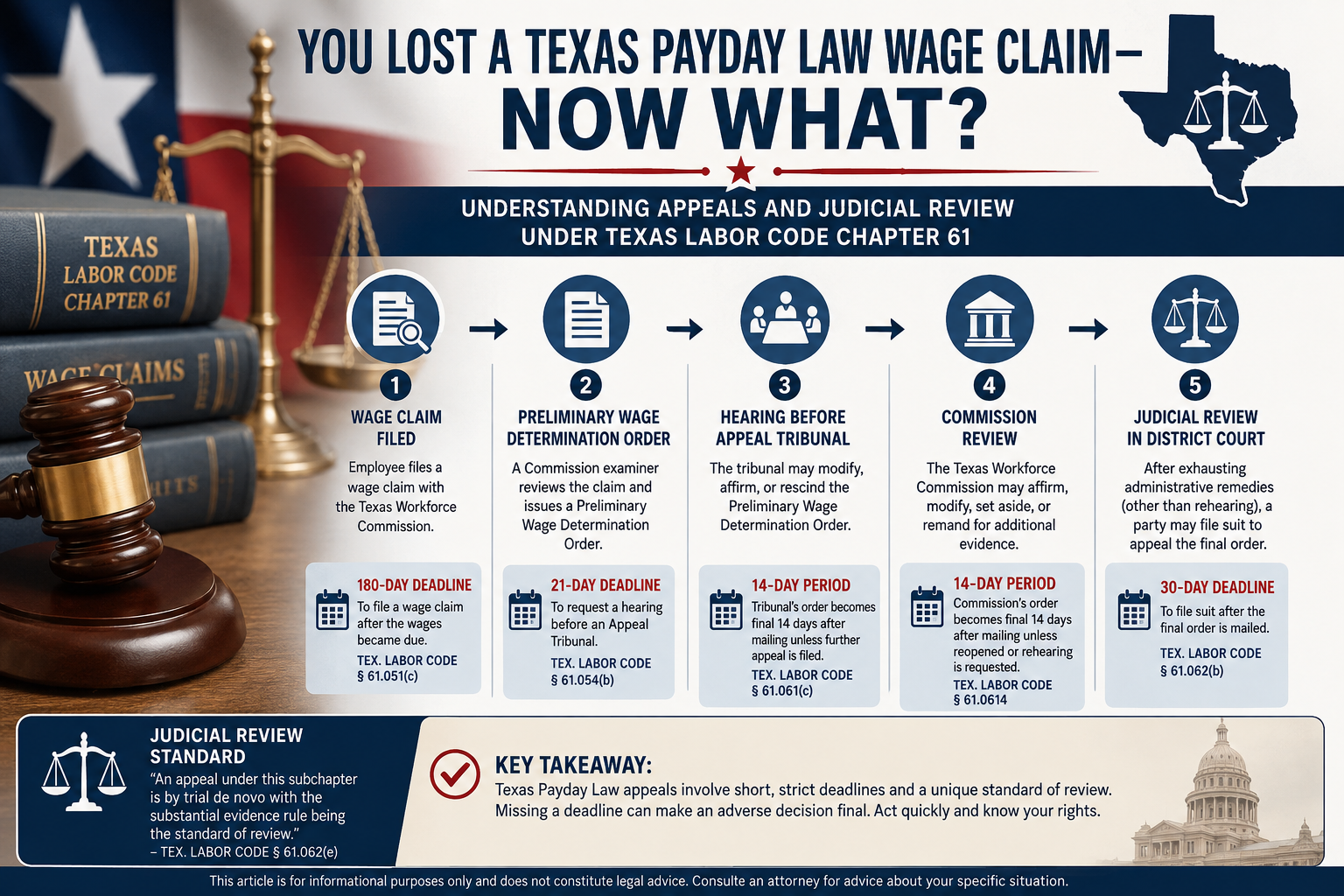
An employee or employer who disagrees with a wage determination may have only 21 days to take the first step in the appeal process. Later stages can involve 14-day deadlines, and judicial review generally must be sought within 30 days after the final Commission order is mailed.
For Texas employees, employers, business owners, and civil litigants, understanding this process can be just as important as understanding whether the wages were actually owed.
Texas Payday Law Claims Begin With the Texas Workforce Commission
Texas Labor Code Chapter 61 regulates the payment of wages by many Texas employers.
An employee who believes that wages have not been properly paid can pursue an administrative wage claim through the Texas Workforce Commission.
But there is an important threshold deadline.
Texas Labor Code § 61.051(c) provides:
“A wage claim must be filed not later than the 180th day after the date the wages claimed became due for payment.”
The statute goes even further:
“The 180-day deadline is a matter of jurisdiction.”
That language matters.
The wage-claim process is not simply an indefinite administrative remedy that an employee can invoke years after a payment dispute arises. The statute establishes a relatively short period in which the administrative claim must be filed.
Accordingly, determining when the particular wages became due can itself become extremely important.
The Texas Workforce Commission Issues a Preliminary Wage Determination Order
After a wage claim is filed, Texas Labor Code § 61.052 requires a Commission examiner to analyze the claim and, when appropriate, investigate it.
The examiner ultimately issues what the statute calls a preliminary wage determination order.
That order may dismiss the wage claim or order payment of wages determined to be due and unpaid.
The word “preliminary,” however, is important.
Either side may challenge that determination.
An employee who believes the award is too small—or whose claim was rejected entirely—may appeal.
An employer ordered to pay wages may also appeal.
But the first appeal deadline arrives quickly.
You Generally Have 21 Days to Appeal the Preliminary Wage Determination
Texas Labor Code § 61.054 provides:
“Either party may request a hearing before a wage claim appeal tribunal to appeal a preliminary wage determination order.”
The request must be made in writing.
More importantly, § 61.054(b) states:
“The request for hearing must be made in writing not later than the 21st day after the date the commission examiner mails the notice of the preliminary wage determination order.”
Notice what triggers the deadline.
The statute refers to the date the examiner mails the notice.
That makes careful attention to the date appearing on the order extremely important.
An employee or employer who receives an unfavorable determination should therefore avoid putting the document aside under the assumption that there will be plenty of time to decide what to do next.
There may not be.
Failing to Appeal Can Make the Preliminary Order Final
The consequences of missing the first appeal deadline can be substantial.
Texas Labor Code § 61.055 provides that if neither party timely requests a hearing:
“the order becomes the final order of the commission for all purposes”
and, critically, neither party is entitled to judicial review under that subchapter.
In other words, a party ordinarily cannot simply ignore the administrative appeal procedure and later decide to take the wage dispute directly to court as an appeal from the TWC determination.
Administrative procedure matters.
This is an excellent example of a broader principle in Texas administrative law: procedural deadlines can determine substantive rights.
A party may believe that the Commission reached the wrong result on the underlying wage dispute. But if that party fails to preserve the available administrative remedies, the merits may never receive further review through the Chapter 61 appellate process.
The First Appeal Goes to a Wage Claim Appeal Tribunal
A timely appeal from the preliminary determination proceeds to a wage claim appeal tribunal.
Under Texas Labor Code § 61.058, the hearing is generally governed by the rules and hearing procedures used by the Commission for unemployment-compensation claims.
The statute also contains an interesting technical provision:
“The hearing is not subject to Chapter 2001, Government Code.”
Chapter 2001 is the Texas Administrative Procedure Act.
That exclusion is important because lawyers accustomed to ordinary Texas administrative proceedings should not automatically assume that every procedural feature of the Administrative Procedure Act governs a Texas Payday Law appeal.
Instead, Chapter 61 creates its own specialized procedural framework.
The Appeal Tribunal Can Change the Preliminary Decision
The wage claim appeal tribunal is not merely checking the examiner's paperwork for obvious mistakes.
Texas Labor Code § 61.059 provides:
“The wage claim appeal tribunal may modify, affirm, or rescind a preliminary wage determination order.”
The tribunal therefore has meaningful authority over the underlying determination.
After the hearing, § 61.060 requires the tribunal to enter a written order concerning wages determined to be due and any penalty assessed.
For both sides, the hearing can be a critical stage of the dispute because evidence and testimony concerning the alleged wages can become part of the administrative record.
Another Short Deadline Follows the Appeal Tribunal's Decision
Receiving the Appeal Tribunal's decision does not necessarily end the case.
Texas Labor Code § 61.061(c) provides:
“The order of the wage claim appeal tribunal becomes final 14 days after the date on which it is mailed unless a further appeal to the commission is initiated as provided by this subchapter.”
Thus, the procedural clock accelerates rather than slows down.
The initial administrative appeal generally involves a 21-daydeadline.
The next stage can involve only 14 days.
For businesses without an internal legal department—and for individual employees handling their own claims—these short deadlines can create significant problems if orders are not reviewed promptly.
The Texas Workforce Commission Can Review the Appeal Tribunal's Decision
Chapter 61 also permits further review by the Commission.
The Commission can review the decision based upon the evidence already submitted and, depending upon the circumstances, affirm, modify, or set aside the Appeal Tribunal's order or direct that additional evidence be taken.
This stage is important because judicial review generally comes after administrative remedies have been exhausted.
A party contemplating eventual litigation should therefore think about the dispute as an administrative case first and a court case second.
That distinction affects both procedure and strategy.
When Does the Commission's Order Become Final?
Texas Labor Code § 61.0614 establishes another important 14-day period.
It provides:
“An order of the commission becomes final 14 days after the date the order is mailed”
unless, before that date, the Commission reopens the appeal or a party files a written motion for rehearing.
A motion for rehearing is therefore available, but it is important to distinguish the availability of a rehearing request from the requirements for ultimately seeking judicial review.
Texas Labor Code § 61.062 expressly states that exhaustion of administrative remedies is required “other than a motion for rehearing.”
Thus, Chapter 61 does not necessarily require a party to pursue every conceivable administrative request before going to court.
A Texas Payday Law Case Can Eventually Reach Civil Court
Once the required administrative process has been exhausted, Texas Labor Code § 61.062 permits judicial review.
The statute provides:
“A party who has exhausted the party's administrative remedies under this chapter, other than a motion for rehearing, may bring a suit to appeal the order.”
Again, however, there is a short deadline.
Section 61.062(b) provides:
“The suit must be filed not later than the 30th day after the date the final order is mailed.”
Thirty days is not much time to evaluate the administrative record, determine litigation strategy, prepare pleadings, identify the proper parties, and file suit.
A party considering judicial review should therefore begin evaluating those issues well before the administrative process reaches its final day.
Who Must Be Sued?
Section 61.062 contains another procedural detail that can easily be overlooked.
The statute requires:
“The commission and any other party to the proceeding before the commission must be made defendants in the suit.”
Thus, an appeal to district court is not simply an ordinary lawsuit between the employee and employer.
The Texas Workforce Commission itself is a required defendant, along with the other party or parties to the administrative proceeding.
That requirement makes careful pleading particularly important.
Where Must the Lawsuit Be Filed?
Chapter 61 also specifies venue.
Under § 61.062(d), the lawsuit generally must be brought in the county where the claimant resides.
If the claimant is not a Texas resident, the statute instead directs that suit be brought in the Texas county where the employer has its principal place of business.
Again, this is not merely a matter of selecting whichever Texas courthouse seems most convenient.
The statute itself directs where judicial review is to occur.
Judicial Review Uses an Unusual Standard
Perhaps the most technically interesting provision appears in Texas Labor Code § 61.062(e).
It states:
“An appeal under this subchapter is by trial de novo with the substantial evidence rule being the standard of review”
in the manner applied to certain appeals from final decisions under Texas unemployment-compensation law.
At first glance, the phrase “trial de novo with the substantial evidence rule” may sound contradictory.
A traditional trial de novo suggests that a court considers the dispute anew.
Substantial-evidence review, by contrast, generally gives significant weight to an administrative decision and asks whether the agency's decision is reasonably supported by the evidence rather than whether the judge would independently reach the same result.
Texas administrative law can combine these concepts in ways that are unfamiliar to litigants accustomed to ordinary civil trials.
The important practical point is that judicial review of a TWC wage determination should not automatically be treated like an ordinary breach-of-contract lawsuit in which the court simply starts from zero and decides who is right.
The applicable statutory standard of review matters.
The Administrative Record Can Become Extremely Important
Because the substantial-evidence framework applies to judicial review, parties should take the administrative proceedings seriously from the beginning.
An employer should not assume:
“If we lose at TWC, we'll just present the real case later in court.”
Likewise, an employee should not assume that an unfavorable administrative record can simply be discarded once a lawsuit is filed.
Documents, compensation agreements, payroll records, commission plans, communications, testimony, and other evidence developed during the administrative proceedings can become extremely important.
That makes preparation at the Appeal Tribunal stage particularly significant.
Wage Disputes Often Turn on Contracts and Employer Policies
Not every Texas wage dispute is simply about whether someone worked a certain number of hours.
Chapter 61 disputes can involve questions concerning:
- commissions;
- bonuses;
- vacation or other paid leave;
- deductions;
- compensation agreements;
- termination of employment;
- when compensation became earned; and
- when particular wages became due.
These disputes can therefore overlap substantially with ordinary Texas contract and business law.
For example, a salesperson may contend that a commission became earned when a customer signed a contract.
The employer may contend that its written compensation plan required the customer to make payment before the commission vested.
The amount of work performed may not be disputed at all.
Instead, the case may turn on the interpretation of the parties' compensation agreement.
Employers Should Preserve Compensation Records
A Texas employer facing a wage claim should preserve the documents necessary to explain how compensation was calculated.
Depending upon the dispute, those documents may include employment agreements, commission plans, employee handbooks, payroll records, time records, emails, termination documents, payment histories, and written deduction authorizations.
Consistency can also matter.
An employer's explanation to the TWC examiner should not casually contradict its position at the Appeal Tribunal hearing or in subsequent litigation.
A wage claim may begin as a relatively small administrative dispute but eventually become a contested proceeding involving testimony, documentary evidence, legal briefing, and judicial review.
Employees Should Not Wait to Investigate Unpaid Wages
Employees face the opposite practical problem.
Because § 61.051 generally imposes a 180-day wage-claim deadline, waiting too long to investigate an unpaid commission, bonus, paycheck, or other compensation dispute can jeopardize the administrative remedy.
An employee should identify:
- what compensation was allegedly earned;
- when it became earned;
- when it became payable;
- what agreement or policy governs the payment; and
- what documents support the amount claimed.
Those questions can determine not only whether wages are owed but also whether a claim is timely.
Texas Payday Law Appeals Are Procedurally Technical
A wage dispute may begin with a simple allegation:
“My employer owes me money.”
But once a Texas Payday Law claim enters the administrative process, the procedure can become considerably more technical.
Chapter 61 creates a progression from the initial wage claim to a Preliminary Wage Determination Order, an Appeal Tribunal hearing, Commission review, and potentially judicial review in civil court.
At several stages, the applicable deadline is measured in days rather than months.
And once the dispute reaches court, the standard of review is not necessarily what an ordinary civil litigant might expect.
For employees and employers alike, the lesson is straightforward:
Do not treat a Texas Workforce Commission wage determination like an informal letter that can be dealt with later.
It may be an appealable legal order with a deadline already running.
Speak With a Texas Attorney About a Wage Claim or Business Dispute
Texas wage disputes can involve much more than unpaid hours.
Commission agreements, bonuses, deductions, employment contracts, company policies, administrative deadlines, and judicial-review procedures can all affect the outcome.
If you are an employee or employer involved in a Texas wage dispute, or if you have received an adverse Texas Workforce Commission wage determination, a Texas attorney can help evaluate the applicable agreement, the administrative record, the appeal deadlines, and the options available under Texas law.
Because Texas Labor Code Chapter 61 contains short and potentially consequential deadlines, obtaining legal advice promptly after receiving a wage determination can be particularly important.
At David C. Barsalou, Attorney at Law, PLLC, we help clients navigate business, family, tax, estate planning, and real estate matters ranging from document drafting to litigation with clarity and confidence. If you’d like guidance on your situation, schedule a consultation today. Call us at (713) 397-4678, email barsalou.law@gmail.com, or reach us through our Contact Page. We’re here to help you take the next step.