Winning a lawsuit does not necessarily mean that the defendant—or the defendant's property—is located in the same state where the judgment was entered.
Suppose a business obtains a judgment against a debtor in Oklahoma, but the debtor later moves to Texas.
Or a creditor wins a lawsuit in New York and discovers that the judgment debtor owns valuable real estate or maintains assets in Texas.
Can the creditor simply take the out-of-state judgment to a Texas sheriff or constable and begin collecting?
Not quite.
But Texas law provides a relatively streamlined procedure for bringing qualifying judgments from other states into Texas.
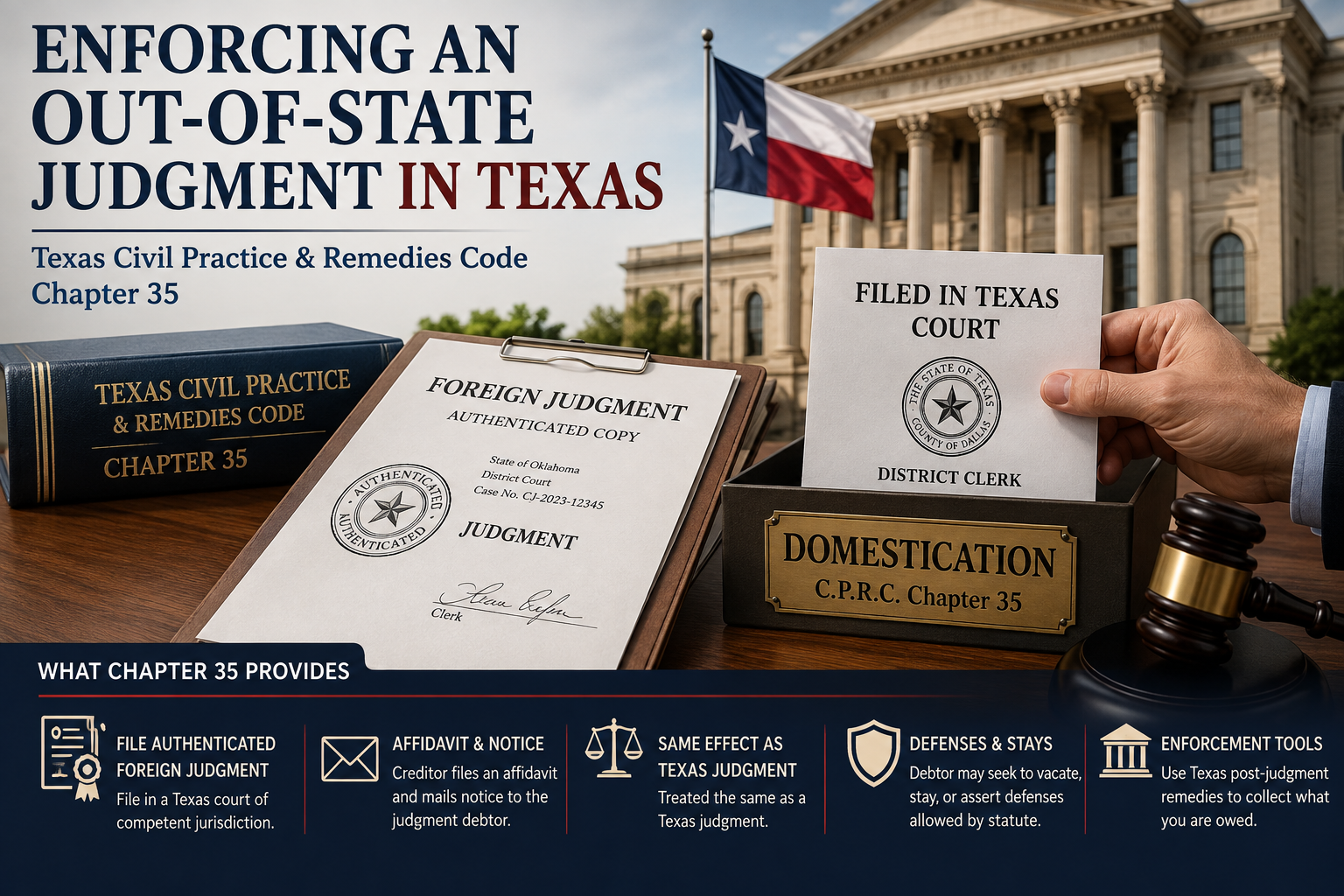
Texas Civil Practice & Remedies Code Chapter 35, known as the Uniform Enforcement of Foreign Judgments Act, allows certain out-of-state judgments to be filed in Texas and generally treated as Texas judgments.
For creditors and debtors alike, understanding this process can be critical because domestication may transform a judgment entered hundreds or thousands of miles away into an enforceable Texas judgment.
What Is a “Foreign Judgment” Under Texas Law?
The terminology can initially be confusing.
In ordinary conversation, a “foreign judgment” might sound like a judgment entered in Mexico, Canada, England, or another country.
Chapter 35 uses the term differently.
Texas Civil Practice & Remedies Code § 35.001 provides:
“In this chapter, ‘foreign judgment’ means a judgment, decree, or order of a court of the United States or of any other court that is entitled to full faith and credit in this state.”
Thus, Chapter 35 principally provides a mechanism for enforcing judgments entitled to full faith and credit in Texas, including qualifying judgments entered by courts of other U.S. states.
Judgments from foreign countries involve a different statutory framework, principally Texas Civil Practice & Remedies Code Chapter 36A.
That distinction matters.
A judgment from Oklahoma and a judgment from France may both colloquially be called “foreign judgments,” but Texas law does not necessarily treat them under the same statutory procedure.
The U.S. Constitution Is the Starting Point
The reason an Oklahoma, California, or New York judgment can potentially be enforced in Texas begins with the Full Faith and Credit Clause of the United States Constitution.
As a general principle, states must recognize qualifying judgments entered by courts of sister states.
Texas has implemented a procedural mechanism for doing so through the Uniform Enforcement of Foreign Judgments Act, codified in Chapter 35.
Section 35.002 expressly provides:
“This chapter may be cited as the Uniform Enforcement of Foreign Judgments Act.”
The Act does not require a judgment creditor to completely retry the original lawsuit simply because the debtor or the debtor's assets are now in Texas.
Instead, the creditor can potentially file the existing judgment in a Texas court.
How Do You Domesticate an Out-of-State Judgment in Texas?
The heart of the statute is Texas Civil Practice & Remedies Code § 35.003.
Section 35.003(a) provides:
“A copy of a foreign judgment authenticated in accordance with an act of congress or a statute of this state may be filed in the office of the clerk of any court of competent jurisdiction of this state.”
Several details are packed into that sentence.
First, the creditor needs an authenticated copy of the judgment.
Second, the judgment must be filed with a Texas court having competent jurisdiction.
Third, the procedure involves more than simply attaching an ordinary photocopy of the judgment to a demand letter.
Proper authentication and filing matter.
Once those statutory requirements are satisfied, however, the legal consequences can be substantial.
Texas Treats the Filed Judgment Like Its Own Judgment
Texas Civil Practice & Remedies Code § 35.003(b) states:
“The clerk shall treat the foreign judgment in the same manner as a judgment of the court in which the foreign judgment is filed.”
Section 35.003(c) goes even further.
A properly filed foreign judgment:
“has the same effect and is subject to the same procedures, defenses, and proceedings for reopening, vacating, staying, enforcing, or satisfying a judgment as a judgment of the court in which it is filed.”
That is the practical power of domestication.
The creditor is not merely placing a copy of another state's judgment into a Texas file.
The statute gives the filed judgment the same general effect as a judgment of the Texas court in which it has been filed.
That can open the door to Texas judgment-enforcement procedures.
Depending on the circumstances and compliance with other applicable Texas law, those procedures may include tools involving abstracts of judgment, judgment liens, writs of execution, turnover proceedings, post-judgment discovery, and other collection remedies.
The Creditor Must File an Affidavit
Chapter 35 contains another technical requirement that should not be overlooked.
Under Texas Civil Practice & Remedies Code § 35.004(a), the creditor or the creditor's attorney must file an affidavit at the time the foreign judgment is filed.
The statute provides:
“At the time a foreign judgment is filed, the judgment creditor or the judgment creditor's attorney shall file with the clerk of the court an affidavit showing the name and last known post office address of the judgment debtor and the judgment creditor.”
This is a simple requirement, but simple procedural requirements can become important when judgment enforcement is contested.
The affidavit identifies the parties and provides the addresses necessary for the statutory notice procedure.
The Judgment Debtor Must Receive Notice
Filing the judgment is not the end of the process.
Section 35.004(b) requires the judgment creditor or the creditor's attorney to:
“promptly mail notice of the filing of the foreign judgment to the judgment debtor”
at the address provided in the affidavit.
The creditor must also file proof of mailing with the court clerk.
The notice itself must contain the name and post office address of the judgment creditor and, if the creditor is represented by a Texas attorney, the attorney's name and address.
After receiving proof of mailing, the clerk notes the mailing on the court's docket.
These requirements help ensure that a debtor knows that a judgment entered elsewhere has now been brought into the Texas court system.
Can the Debtor Challenge the Foreign Judgment?
Domestication does not necessarily eliminate every possible defense.
Section 35.003(c) expressly states that the filed judgment remains subject to procedures and defenses involving:
- reopening;
- vacating;
- staying;
- enforcing; and
- satisfying the judgment.
But domestication is generally not an opportunity to simply retry the merits of the original lawsuit because the losing party dislikes the result.
The distinction is important.
If a defendant litigated a contract dispute in another state, lost, exhausted the available procedures for challenging the judgment, and then moved to Texas, the defendant ordinarily cannot treat Texas domestication as an entirely new trial on whether the original contract was breached.
Questions involving jurisdiction, finality, satisfaction, procedural defects, stays, and other legally recognized grounds can present different issues.
Foreign-judgment practice can therefore become surprisingly technical even though Chapter 35 was designed to simplify interstate enforcement.
What If the Original Judgment Is Being Appealed?
Texas law specifically addresses this problem.
Suppose the creditor files an Oklahoma judgment in Texas while the debtor is actively appealing that judgment in Oklahoma.
Texas Civil Practice & Remedies Code § 35.006 permits—and in certain circumstances requires—the Texas court to stay enforcement.
Among other circumstances, § 35.006(a) applies if the judgment debtor shows that an appeal is pending or will be taken, that the time for appeal has not expired, or that a stay of execution has been or will be requested, together with the required security.
The statute provides that under the specified circumstances:
“the court shall stay enforcement of the foreign judgment”
until the appeal is concluded, the time for appeal expires, or the applicable stay terminates.
This prevents domestication from becoming an easy way to circumvent a legitimate appellate stay in the state where the judgment originated.
Texas Law Still Requires Security When Appropriate
Section 35.006 also reflects an important principle of judgment enforcement: a debtor seeking to suspend collection may have to provide security.
Under subsection (b), when the debtor establishes a ground on which enforcement of an ordinary Texas judgment would be stayed, the Texas court may stay enforcement of the foreign judgment for an appropriate period and require the same security that Texas law ordinarily requires for suspending enforcement.
Thus, filing a motion or announcing an intention to challenge the judgment does not necessarily create an automatic indefinite shield against collection.
The specific procedural posture matters.
Domestication Is Not Free
Chapter 35 also addresses filing fees.
Texas Civil Practice & Remedies Code § 35.007(a) provides:
“A person filing a foreign judgment shall pay to the clerk of the court the amount as otherwise provided by law for filing suit in the courts of this state.”
Additional enforcement proceedings may carry their own fees.
From the creditor's perspective, this is another reason to investigate whether the debtor actually has reachable Texas assets before spending additional money pursuing interstate enforcement.
A judgment may be legally enforceable and still be economically difficult to collect.
Chapter 35 Is Not the Only Available Procedure
One particularly interesting provision appears in § 35.008:
“A judgment creditor retains the right to bring an action to enforce a judgment instead of proceeding under this chapter.”
In other words, the Uniform Enforcement of Foreign Judgments Act provides a streamlined statutory mechanism, but it does not necessarily eliminate the traditional option of bringing an action on the judgment.
The best procedural route can depend on the nature of the judgment, its age, possible defenses, the jurisdiction in which it originated, and the assets being pursued.
Old Foreign Judgments Can Present Limitations Problems
Judgment creditors should also be careful about waiting too long.
Texas Civil Practice & Remedies Code § 16.066 contains limitations provisions concerning actions on foreign judgments.
Among other things, § 16.066(a) provides:
“An action on a foreign judgment is barred in this state if the action is barred under the laws of the jurisdiction where rendered.”
Subsection (b) also imposes a Texas limitation in specified circumstances involving a person who has resided in Texas for ten years before the action.
The age of the judgment therefore matters.
A creditor who possesses a judgment from another state should not assume that it can simply sit unused indefinitely and then be enforced in Texas whenever convenient.
A Judgment From Another Country Is Different
Chapter 35 should not be confused with Texas Civil Practice & Remedies Code Chapter 36A.
Chapter 36A governs recognition of certain foreign-country judgments.
That statute contains substantially different requirements and defenses, including questions concerning due process, personal jurisdiction, subject-matter jurisdiction, notice, fraud, public policy, conflicting judgments, inconvenient forums, and the integrity of the foreign proceeding.
For example, § 36A.004 provides circumstances in which a Texas court may not recognize a foreign-country judgment and other circumstances in which the court is not required to recognize it.
That is a very different inquiry from ordinary enforcement of a sister-state judgment entitled to full faith and credit.
So:
California judgment? Chapter 35 may apply.
Canadian judgment? Chapter 36A may be the relevant starting point.
The word “foreign” can therefore hide a major procedural distinction.
Why Domestication Matters in Real Life
Consider a simple example.
A contractor obtains a $75,000 judgment against a former customer in another state.
The customer moves to Texas.
The creditor then discovers that the debtor owns nonexempt property or other assets in Texas.
The original out-of-state court may have entered a perfectly valid judgment, but practical collection efforts now need to reach property located here.
Chapter 35 provides the bridge.
Once the qualifying judgment is properly authenticated, filed, and processed under Texas law, it can generally be treated like a judgment of the Texas court in which it was filed.
At that point, the dispute may shift from:
“Who won the lawsuit?”
to:
“What Texas assets can legally be reached to satisfy the judgment?”
That is an entirely different phase of litigation.
The Bottom Line
A judgment entered in another state does not become worthless merely because the debtor moves to Texas.
Texas Civil Practice & Remedies Code Chapter 35 provides a streamlined mechanism for filing qualifying foreign judgments in Texas and generally giving them the same effect as Texas judgments.
But the process remains technical.
The judgment must qualify for full faith and credit, an authenticated copy must be filed in a court of competent jurisdiction, the statutory affidavit and notice requirements must be addressed, and questions involving appeals, stays, defenses, limitations, and collection remedies may still arise.
For judgment creditors, domestication can turn an out-of-state piece of paper into a practical Texas collection tool.
For judgment debtors, receiving notice that a foreign judgment has been filed in Texas should not be ignored. It may mean that a judgment entered elsewhere has now arrived where the debtor—and the debtor's assets—actually are.
This article is for general informational purposes only and does not constitute legal advice. Foreign-judgment enforcement can involve jurisdictional, procedural, limitations, and asset-exemption issues that depend heavily on the particular judgment and the facts of the case.
At David C. Barsalou, Attorney at Law, PLLC, we help clients navigate business, family, tax, estate planning, and real estate matters ranging from document drafting to litigation with clarity and confidence. If you’d like guidance on your situation, schedule a consultation today. Call us at (713) 397-4678, email barsalou.law@gmail.com, or reach us through our Contact Page. We’re here to help you take the next step.