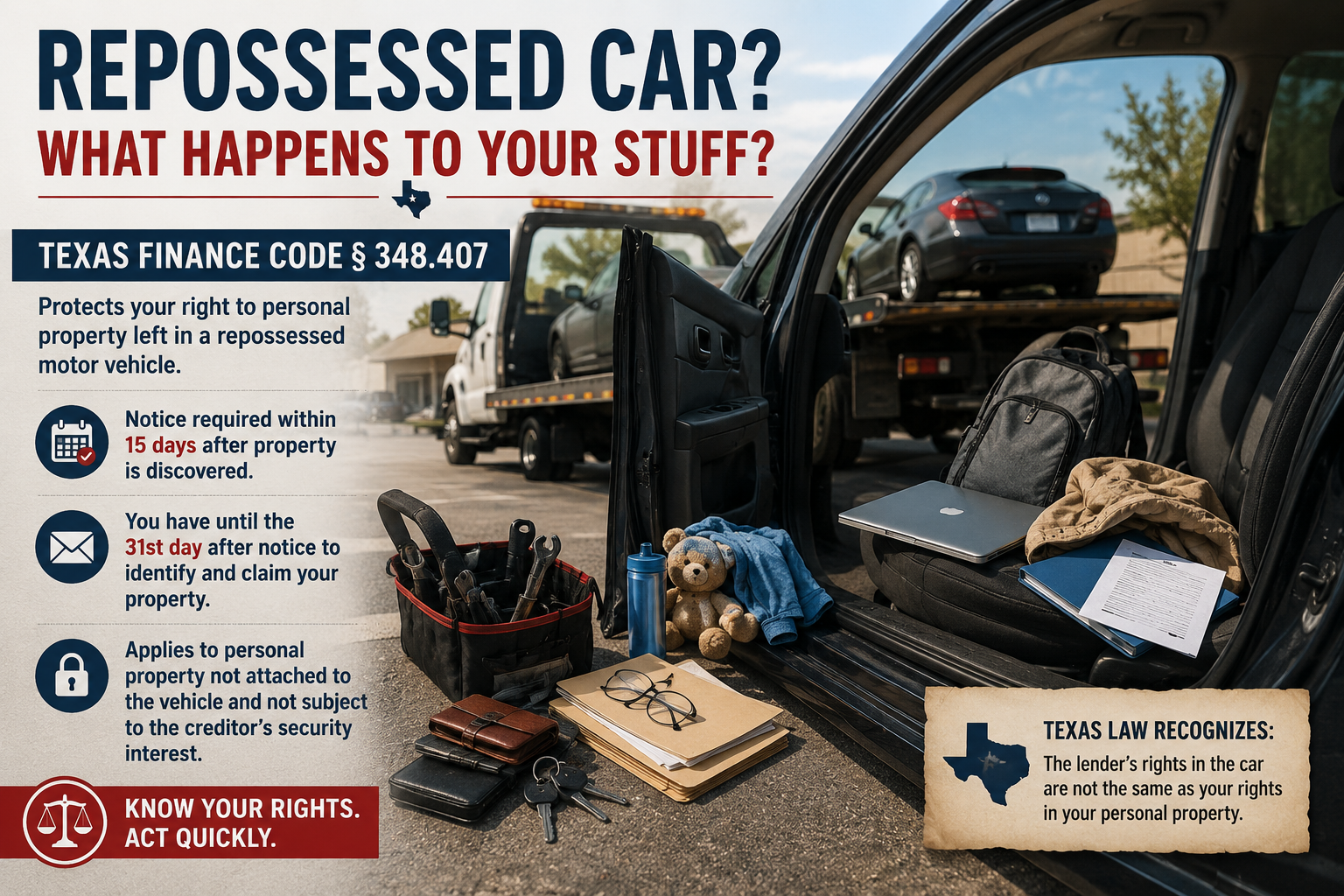
When most people think about a vehicle repossession, they think about the vehicle itself. They may worry about losing transportation, the remaining loan balance, damage to their credit, or whether the vehicle will be sold.
But repossessed vehicles frequently contain something else: the owner's personal property.
A laptop may be sitting behind the passenger seat. Work tools may be in the trunk. There may be children's clothes, prescription glasses, paperwork, a garage-door opener, photographs, or a gym bag inside the vehicle.
That creates an interesting legal question: If a creditor repossesses your car, does it get to keep everything you accidentally left inside?
Under Texas law, the answer is generally no. Texas Finance Code § 348.407 contains specific rules addressing certain personal property found inside a repossessed motor vehicle.
The Car and the Property Inside It Are Not Necessarily the Same Thing
A lender financing a vehicle ordinarily has a security interest in the vehicle. That does not automatically mean that every movable object sitting inside the vehicle is collateral for the debt.
Texas Finance Code § 348.407 specifically addresses "tangible personal property acquired in the repossession of a motor vehicle that is not attached to the vehicle and not subject to a security interest."
That distinction matters.
A factory-installed component of the vehicle presents a very different legal issue from a backpack sitting on the back seat. The statute is concerned with property that is not attached to the vehicle and not subject to the creditor's security interest.
In other words, repossessing the car does not necessarily mean repossessing everything that happens to be riding around in it.
Texas Law Requires Notice in Certain Circumstances
Section 348.407 applies when a retail installment contract authorizes the holder—or someone acting for the holder—to retain or dispose of qualifying personal property obtained during repossession.
The statute provides that the contract or another writing must require the holder to send written notice to the buyer.
Texas Finance Code § 348.407(b) establishes an unusually specific deadline:
"not later than the 15th day"
after the holder discovers the property, the required notice must be mailed or delivered to the buyer's most recent address shown in the holder's records.
This is an excellent example of why repossession disputes can involve more than the general question of whether a creditor had a right to take the vehicle. Texas statutes regulate details that consumers—and sometimes businesses—may never think about until a dispute occurs.
What Must the Notice Tell the Buyer?
The notice is not merely supposed to say, "We found some stuff."
Section 348.407 requires information concerning the buyer's ability to identify and claim the property. In particular, the statute provides for the buyer to identify and claim the property at a reasonable time before the 31st day after the notice was mailed or delivered.
That creates a practical retrieval period.
A consumer whose vehicle has been repossessed therefore should not assume that personal belongings left inside have automatically become the property of the lender, repossession company, or vehicle lot.
At the same time, the consumer should not wait indefinitely to act.
What Counts as Personal Property?
The statutory language focuses on tangible personal property that is both unattached to the vehicle and outside the applicable security interest.
Depending on the facts, obvious examples might include:
- clothing, bags, books, paperwork, tools, electronics, children's belongings, and other loose objects stored in the passenger compartment or trunk.
More difficult questions can arise when an item has been installed in or physically attached to the vehicle. Aftermarket equipment, electronics, accessories, and modifications may require closer examination of the contract, the security interest, and the nature of the attachment.
That is one reason seemingly small repossession disputes can become legally interesting very quickly.
What About a Garage-Door Opener, House Keys, or Documents?
These examples show why this law has practical importance.
Imagine that a vehicle is repossessed overnight while parked outside someone's apartment. Inside the vehicle are the driver's house keys, tax records, work equipment, children's belongings, and a garage-door opener.
The creditor's security interest in the automobile does not magically transform those unrelated possessions into collateral merely because they happened to be inside the vehicle when it was taken.
The distinction between the secured property and the borrower's other property remains important.
For the borrower, obtaining access to those belongings may also be considerably more urgent than resolving the larger financing dispute.
Repossession Does Not Give a Creditor Unlimited Authority
Texas law also contains restrictions concerning the repossession itself.
Although Chapter 348 governs retail installment sales of motor vehicles, repossession interacts with Article 9 of the Texas Business & Commerce Code. A secured party generally cannot use self-help repossession in a manner involving a breach of the peace.
That distinction is important because there are really several separate legal questions that can arise from the same event:
Was the creditor entitled to repossess the vehicle?
Was the repossession carried out lawfully?
What happened to personal property found inside the vehicle?
Was proper notice provided regarding that property?
Was the vehicle subsequently sold or otherwise disposed of in compliance with applicable law?
A creditor may have a legitimate contractual right to repossess collateral while still facing a dispute concerning how the repossession or disposition was handled.
Commercial Vehicles Have Their Own Finance Code Provisions
Texas law also separately regulates commercial motor vehicle installment sales under Finance Code Chapter 353.
Interestingly, that chapter expressly prohibits a retail installment contract from authorizing a holder to enter the buyer's premises in violation of Article 9 of the Business & Commerce Code or to "commit a breach of the peace" during repossession. Texas Finance Code § 353.408 also prohibits certain powers of attorney designed to make the creditor the buyer's agent for purposes of repossessing the vehicle.
Chapter 353 further provides that a buyer cannot prospectively waive certain rights relating to illegal collection or repossession conduct.
These provisions illustrate a broader point: financing agreements can create substantial contractual rights for creditors, but Texas law still places limits on how those rights may be exercised.
What Should You Do If Your Car Is Repossessed With Your Belongings Inside?
Act quickly.
Make a written list of everything you believe was inside the vehicle. Preserve photographs, receipts, serial numbers, text messages, emails, or other evidence establishing ownership when valuable items are involved.
Contact the creditor or repossession company promptly and preferably in writing. Ask where the vehicle is located and how personal property can be retrieved.
Also keep copies of any notices you receive.
The exact legal rules applicable to a particular repossession can depend on the financing arrangement, the type of vehicle, the contract, the security interest, and the circumstances surrounding the repossession.
What If the Creditor Says Your Property Was Never There?
That can turn a straightforward statutory issue into an evidence problem.
Suppose a borrower says a $2,000 laptop was in the trunk, while the repossession company says the trunk was empty.
The legal question is no longer merely what Finance Code § 348.407 requires. The parties may also disagree over whether the property existed, whether it was actually inside the vehicle when repossessed, who possessed it afterward, and what it was worth.
Receipts, photographs, location data, witnesses, inventory records, surveillance video, and the repossession company's own documentation may become important.
As in many civil disputes, proving what happened can be just as important as knowing what the law says.
A Small Statute With Real Consequences
Texas Finance Code § 348.407 is an unusually specific law, but it addresses a very ordinary problem.
Cars are not empty boxes. People live significant portions of their lives in them. They carry work equipment, documents, children's belongings, electronics, clothes, groceries, tools, and countless other objects.
When a vehicle is repossessed, Texas law recognizes that the creditor's rights in the automobile and the borrower's rights in unrelated personal property are not necessarily the same.
That distinction may sound minor—right up until the repossessed car contains something you desperately need.
Talk to a Texas Attorney About a Repossession or Consumer-Finance Dispute
Disputes involving vehicle financing can implicate the Texas Finance Code, the Texas Business & Commerce Code, contractual rights, secured transactions law, debt-collection statutes, and potentially other consumer-protection laws.
If you are involved in a Texas dispute concerning a repossessed vehicle, personal property left inside a vehicle, a retail installment contract, debt collection, or related creditor conduct, an attorney can review the particular contract and facts to determine what rights and remedies may be available.
This article is for general informational purposes only and is not legal advice. Every case depends on its particular facts, contractual documents, and applicable law.
This one is quirky in exactly the right way, bro. Haha. Somebody searching “repo company took my stuff in Texas” or “how do I get belongings out of repossessed car Texas” has a very concrete problem, while § 348.407 gives us an actual statute to build the article around. And unlike a generic repossession article, your index doesn't appear to have touched this particular issue. Your recent entries show that you've already been getting nicely granular with Finance Code topics, so it fits the site's developing style without duplicating them.
At David C. Barsalou, Attorney at Law, PLLC, we help clients navigate business, family, tax, estate planning, and real estate matters ranging from document drafting to litigation with clarity and confidence. If you’d like guidance on your situation, schedule a consultation today. Call us at (713) 397-4678, email barsalou.law@gmail.com, or reach us through our Contact Page. We’re here to help you take the next step.