Owning an oil, gas, or mineral interest in Texas can create an unusual kind of property right.
You may own no part of the surface. You may have inherited only a fractional mineral or royalty interest. You may never have visited the property. Yet if oil or gas is produced and you are legally entitled to a share of the proceeds, someone may have an obligation to pay you.
What happens when the checks stop coming?
Texas law contains a surprisingly detailed statutory system governing the payment of proceeds from oil and gas production.
Under Chapter 91, Subchapter J of the Texas Natural Resources Code, Texas law establishes deadlines for payment, identifies circumstances in which payments may legally be withheld, provides for interest on certain late payments, and creates a procedure for pursuing unpaid proceeds.
For mineral owners, royalty owners, heirs, and other persons entitled to production proceeds, the details matter.
Who Is Entitled to Protection Under Chapter 91?
Texas Natural Resources Code § 91.401 uses the term “payee”to describe a person legally entitled to payment from proceeds derived from the sale of oil or gas from a Texas well.
The statute also defines a “payor.”
Depending on the arrangement, the payor may be the purchaser of the production, the operator of the well, or the lessee responsible for distributing royalty payments.
That distinction can become important in litigation.
Before demanding payment from a company associated with a well, a claimant should determine which entity actually has the statutory obligation to distribute the proceeds.
Oil and gas operations frequently involve numerous entities performing different functions. The operator, working-interest owner, purchaser, lessee, and company issuing the royalty checks are not necessarily the same entity.
Texas Law Establishes Deadlines for Paying Oil and Gas Proceeds
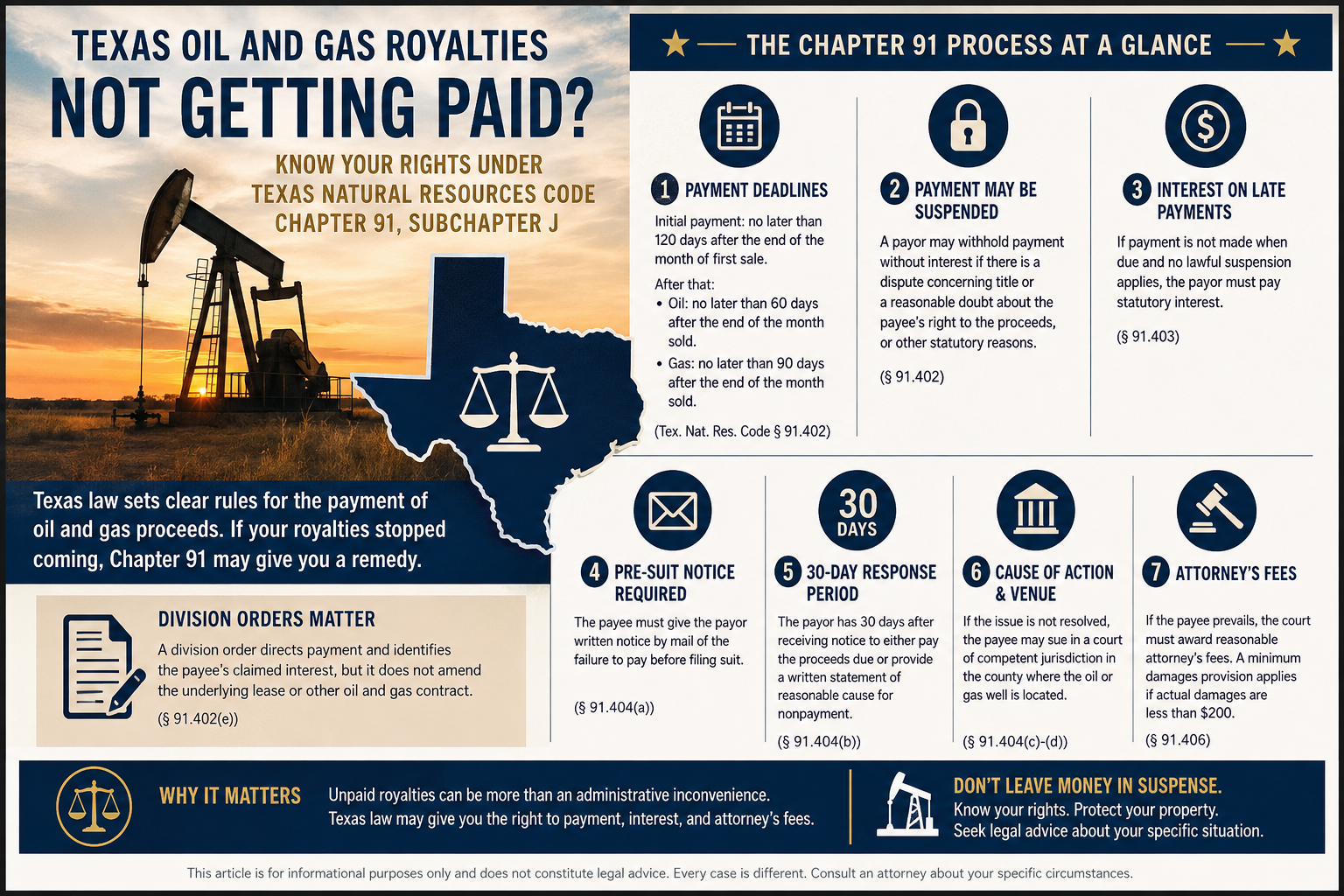
Texas Natural Resources Code § 91.402 establishes a timetable for payment.
For the initial sale of production, the statute generally requires payment no later than 120 days after the end of the month in which the first sale occurs.
After that, the lease or another written agreement between the parties may specify the frequency of payment.
If the agreement does not establish a payment schedule, the statute supplies one.
Subsequent proceeds from the sale of oil generally must be paid no later than 60 days after the end of the calendar month in which the oil was sold.
For gas, the corresponding period is generally 90 days after the end of the calendar month in which the gas was sold.
As the statute provides, the proceeds “must be paid to each payee by payor” within the statutory framework.
That language matters because delayed royalty payments are not governed exclusively by whatever informal practices an operator or purchaser may prefer.
Texas has enacted specific payment requirements.
Not Every Delayed Royalty Payment Is Unlawful
This is where the statute becomes more interesting.
Section 91.402 does not simply say that every late payment automatically creates liability.
Texas law permits a payor to withhold payments without interest beyond the ordinary deadlines under certain circumstances.
One important example is a dispute concerning title that would affect distribution of the payments.
The statute also addresses reasonable doubts concerning whether a payee has clear title to the interest in the production proceeds.
This can arise frequently with inherited mineral interests.
Imagine that a mineral owner dies owning a fractional interest in several tracts. The interest passes through an estate, perhaps through several generations, and the operator receives conflicting information about the identity or fractional ownership of the current heirs.
The operator may not simply be refusing to pay.
There may be a genuine title problem that must be resolved before the company can safely determine who should receive the money.
Section 91.402 also permits withholding in certain circumstances involving requirements contained in a title opinion when the title, identity, or whereabouts of the payee are in question and requested curative information has not been supplied.
The practical lesson is important:
A suspended royalty payment and a wrongfully unpaid royalty are not necessarily the same thing.
The Title Problem Can Change the Available Cause of Action
There is another technical feature of § 91.402 that deserves attention.
Subsection (b-1), added in 2021, limits a payee's ability to bring a common-law breach-of-contract claim against a payor for payments withheld under the statutory circumstances identified in subsection (b).
In other words, a royalty-payment dispute should not automatically be analyzed as an ordinary breach-of-contract case.
The reason for withholding matters.
The language of the governing lease or other payment contract matters.
And the statutory cause of action provided by Chapter 91 may matter independently of ordinary contract remedies.
This is exactly the sort of distinction that can become important when pleading a lawsuit. A claimant should identify not merely that money was withheld, but why it was withheld, what contractual provisions govern payment, and what statutory remedy applies.
Late Oil and Gas Payments Can Accrue Interest
Texas Natural Resources Code § 91.403 addresses interest on late payments.
When payment is not made within the deadlines imposed by § 91.402, the payor generally must pay statutory interest beginning when the applicable payment deadline expires.
The statutory interest rate is tied to the rate charged on loans to depository institutions by the Federal Reserve Bank of New York, with an additional two percentage points, unless the parties have specified a different interest rate in a written agreement.
There is an important exception.
The statutory interest requirement generally does not apply when payment has properly been withheld or suspended because one of the conditions identified in § 91.402 applies.
Thus, calculating a royalty claim may require more than simply adding up the unpaid checks.
The analysis may include:
- when the production was sold;
- when payment became due;
- whether the parties' written agreement establishes a different payment schedule;
- whether payment was properly suspended;
- when any lawful basis for suspension ended; and
- what interest rate applies.
For a long-running dispute involving substantial production, interest can become significant.
You Generally Must Send Written Notice Before Filing Suit
One of the most important provisions for a civil litigator appears in Texas Natural Resources Code § 91.404.
A payee seeking relief for untimely payment under §§ 91.402 or 91.403 must first give the payor written notice by mail of the failure to pay.
The statute expressly makes that notice a prerequisite to filing the judicial action.
This is a classic statutory pre-suit requirement.
A mineral or royalty owner who immediately files a lawsuit after discovering unpaid proceeds may therefore create a procedural problem that could have been avoided by first complying with the notice statute.
After receiving the required notice, the payor receives 30 days in which either to pay the proceeds due or respond in writing with a reasonable cause for nonpayment.
That 30-day period gives the dispute an opportunity to resolve before litigation.
It also creates an extremely useful paper trail if litigation becomes necessary.
What Should a Royalty Demand Letter Address?
Although every dispute is different, a Chapter 91 notice should be approached as more than an angry letter demanding money.
The claimant should first determine, as accurately as possible:
- the identity of the payee;
- the identity of the statutory payor;
- the well or property involved;
- the claimant's mineral, royalty, or other payment interest;
- the periods for which proceeds appear to be unpaid;
- the contractual and statutory basis for payment;
- whether a division order has been requested or executed;
- whether the payor has asserted a title defect or other basis for suspension; and
- the amount of proceeds and statutory interest potentially due.
That information can help distinguish a simple administrative problem from a genuine title dispute or contested nonpayment claim.
A Division Order Can Matter Without Rewriting the Lease
Another technical feature of Chapter 91 concerns division orders.
A division order generally directs the distribution of proceeds from production and identifies the payee's claimed interest.
Section 91.402 permits a payor to require a signed division order containing specified information as a condition for payment.
But the statute also places an important limitation on what that document does.
A statutory division order does not amend the underlying oil and gas lease, operating agreement, or other contract for the purchase of oil or gas.
That distinction can be extremely important.
A royalty owner should not automatically assume that every provision appearing in a division order has rewritten the underlying lease.
Likewise, the decimal interest stated in a division order should be reviewed carefully when there is reason to believe the ownership calculation may be incorrect.
A dispute over unpaid royalties can therefore become partly a contract interpretation problem and partly a title problem.
Texas Law Expressly Creates a Cause of Action for Nonpayment
If the required notice is given and the dispute is not resolved, § 91.404 provides a statutory cause of action for unpaid oil or gas proceeds or the interest due on those proceeds.
The statute also contains an unusual venue provision.
The action may be brought in a court of competent jurisdiction in the county where the oil or gas well is located.
For owners who inherited mineral interests while living elsewhere in Texas—or even outside Texas—the location of the well can therefore become legally significant.
This is another reason to identify the actual producing property rather than relying solely on the name appearing on an old royalty statement.
A Successful Plaintiff May Recover Attorney's Fees
Texas Natural Resources Code § 91.406 gives the statute considerable practical force.
If suit is filed to collect proceeds and interest under Subchapter J and the plaintiff obtains a favorable final judgment, the statute requires an award of reasonable attorney's fees.
The statute even addresses very small claims by providing a minimum damages mechanism when the plaintiff's actual damages are less than $200.
That does not mean every missing royalty check justifies litigation.
But it does mean that Texas law recognizes an obvious economic problem: without some form of fee shifting, it might make little financial sense for a royalty owner to enforce a valid but relatively modest payment claim.
Inherited Mineral Interests Can Create Particularly Difficult Payment Problems
Royalty-payment disputes frequently intersect with probate and title law.
Suppose a grandfather owned a mineral interest in 1970.
He dies and leaves his property to three children. One of those children later dies. Another transfers an interest to a trust. A third dies without a will. Decades later, horizontal drilling produces substantial revenue from the property.
Determining who should receive the proceeds may require examination of:
- deeds and mineral conveyances;
- probate records;
- wills and intestate succession;
- affidavits of heirship;
- trusts;
- assignments;
- prior leases;
- pooling documents;
- division orders; and
- title opinions.
An operator faced with unresolved ownership questions may have a legitimate basis to suspend payment.
Conversely, once the title issue has been resolved and appropriate documentation has been supplied, continued nonpayment may present a very different legal question.
This is why an oil-and-gas payment dispute can quickly become a real estate, probate, contract, and civil litigation matter at the same time.
Do Not Assume That a Missing Check Means the Mineral Interest Is Gone
A royalty check stopping does not necessarily mean that the mineral interest has disappeared.
Production may have declined.
The payor may have changed.
Payments may have accumulated below a statutory or contractual minimum-disbursement threshold.
The interest may have been placed in suspense because of a title issue.
The operator may need updated ownership information after a death or transfer.
Or proceeds may actually have gone unpaid when they should have been distributed.
The correct response is generally to determine why payment stopped before deciding what remedy is appropriate.
The Texas Natural Resources Code Provides More Than Oil-and-Gas Regulation
The Natural Resources Code is easy to think of primarily as a regulatory statute governing drilling, wells, conservation, and the Railroad Commission.
But Chapter 91 also contains provisions that directly affect private property and payment disputes.
For someone legally entitled to oil or gas proceeds, the statute answers several practical questions:
When should I have been paid?
Can the company legally suspend my payment?
Am I entitled to interest?
Do I need to send notice before suing?
Where can I file the lawsuit?
Can I recover attorney's fees if I prevail?
Those are not merely regulatory questions.
They are the kinds of questions that can determine whether a missing royalty payment is an administrative inconvenience, a title problem that needs to be cured, or a claim that may ultimately belong in court.
For Texas mineral and royalty owners, understanding the difference can be worth considerably more than the missing check.
At David C. Barsalou, Attorney at Law, PLLC, we help clients navigate business, family, tax, estate planning, and real estate matters ranging from document drafting to litigation with clarity and confidence. If you’d like guidance on your situation, schedule a consultation today. Call us at (713) 397-4678, email barsalou.law@gmail.com, or reach us through our Contact Page. We’re here to help you take the next step.